Have you ever received a text that says “id” and wondered what the person meant? You are not alone. Online conversations are full of short words, abbreviations, and slang that can be confusing when you first encounter them. Two small letters can have different meanings depending on the sentence, the conversation, and the person using them.
So, what does ID mean in text slang? The answer depends on the context. “ID” most commonly stands for identification, especially when someone is talking about an ID card, an account, or proving who they are. In casual texting, lowercase “id” can also be an informal way of typing “I’d,” meaning “I would” or “I had.” Some people may use “id” as shorthand for “I don’t,” but that interpretation is less standardized than familiar abbreviations such as “IDK” and “IDC.”
Understanding the words around it is the easiest way to figure out what someone means. In this guide, you will learn the different meanings of ID, how people use it in text messages and on social media, what it means in common conversations, and how to reply without feeling confused.
Quick Answer: What Does ID Mean in Text?
In everyday digital communication, ID usually means identification, but its intended meaning can change when it appears in lowercase or as part of a sentence.
Here are the main possibilities:
- ID = Identification: An identity card, document, username identifier, or other way of confirming who someone is.
- id = I’d: An informal spelling of “I would” or “I had,” with the apostrophe omitted.
- id = I don’t: An occasional informal shorthand that some people may use, although it is not universally understood.
- IDK = I don’t know: A widely recognized texting abbreviation.
- IDC = I don’t care: Another common abbreviation used in informal conversations.
For example, if someone texts, “Bring your ID to the event,” they are asking for identification. If a friend writes, “id love to come,” they probably mean “I’d love to come.”
The key is not to assume that every version of “id” means the same thing. Read the entire message before deciding what the sender intended.
1. ID Means Identification
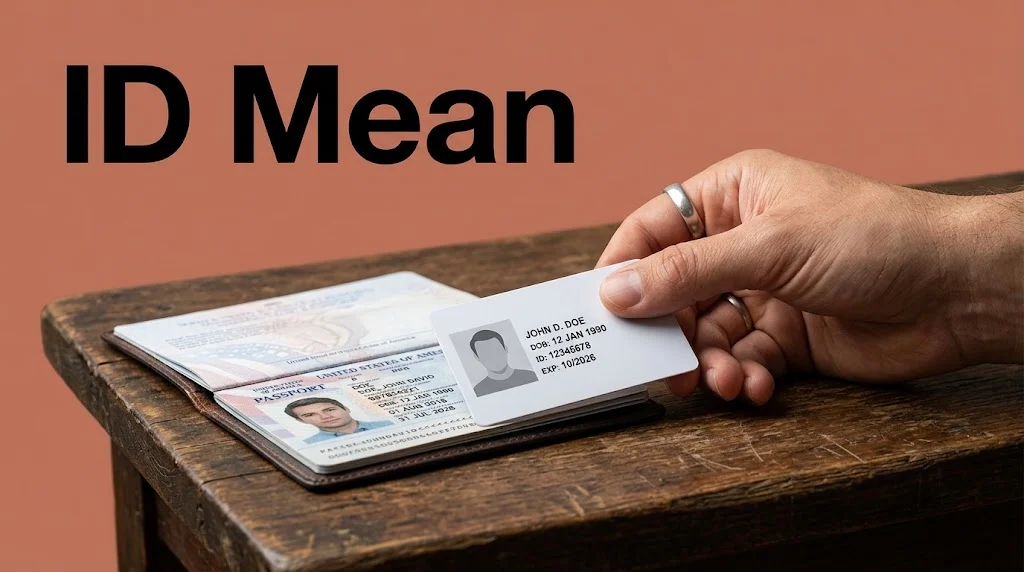
One of the most established meanings of ID is identification. People use the abbreviation when referring to a document, card, or other information that helps confirm someone’s identity.
This meaning is especially common in conversations about travel, school, work, age checks, official appointments, and entering a building or event.
For example:
Friend: “Don’t forget your ID tomorrow.”
You: “Got it. I’ll bring my driver’s license.”
In this conversation, ID refers to an identification document.
Here are a few more examples:
Example 1: Going to a concert
“Do they check ID at the entrance?”
The sender wants to know whether staff ask visitors to prove their identity or age.
Example 2: Meeting someone
“Can you send me your employee ID?”
The person is asking for an identifier associated with the sender’s workplace.
Example 3: Traveling
“I left my ID at home.”
The person forgot an identification document they may need for the trip.
Example 4: Online accounts
“What’s your user ID?”
This usually means the identifier associated with an account, rather than a physical identification card.
The Cambridge English Dictionary also defines “ID” as an abbreviation for identification, supporting its established use in everyday English.
When ID appears in a practical conversation involving documents, accounts, verification, or security, identification is generally the safest interpretation.
2. Can “id” Mean “I’d” in a Text Message?
Yes. In casual digital writing, some people leave out apostrophes to type faster. As a result, “I’d” may appear as “id.”
The contraction “I’d” has two standard meanings:
- “I would”
- “I had”
The rest of the sentence usually tells you which meaning applies.
For example:
Message: “id love to visit someday.”
Meaning: “I’d love to visit someday.”
Here, the sender is expressing a wish or desire.
Another example:
Message: “id help you if I could.”
Meaning: “I’d help you if I could.”
The phrase “I’d help” means “I would help.”
Now consider a different message:
Message: “id already finished when you called.”
Depending on the intended wording, this may be an informal spelling of “I’d already finished,” meaning “I had already finished.”
Notice how “id” does not need to be a new slang word in these examples. It can simply be a contraction typed without punctuation.
More examples of “id” meaning “I’d”
| Text message | Intended meaning |
|---|---|
| “id go with you” | I’d go with you. |
| “id rather stay home” | I’d rather stay home. |
| “id love that” | I’d love that. |
| “id be happy to help” | I’d be happy to help. |
| “id already seen it” | I’d already seen it. |
These spellings are informal and can be ambiguous. In standard writing, keep the apostrophe in “I’d.” In a casual conversation, the missing apostrophe may not matter if the meaning is obvious.
This distinction is particularly useful when you’re trying to understand a message that begins with “id” followed by words such as “love,” “go,” “rather,” or “be.”
3. Does ID Mean “I Don’t” in Text Slang?
Sometimes, but this meaning needs a little explanation.
Some people use lowercase “id” as a very informal shorthand for “I don’t.” However, it is not a universally established abbreviation, so readers may interpret it differently.
For example, someone might write:
- “id know what to say” when intending “I don’t know what to say.”
- “id want to argue” when intending “I don’t want to argue.”
- “id think so” when intending “I don’t think so.”
These examples depend heavily on context and the sender’s personal typing habits. Not everyone will understand “id” this way.
In particular, be careful with the first example. “id know what to say” could be interpreted differently if the reader assumes “id” means “I’d.” The missing punctuation makes the message harder to understand.
For this reason, it is more accurate to treat “I don’t” as a possible informal interpretation rather than the standard meaning of ID in texting.
If you want to communicate clearly, use the familiar abbreviations that already express the intended meaning.
Common alternatives to “id”
IDK means “I don’t know.”
Example: “IDK what time the movie starts.”
IDC means “I don’t care.”
Example: “IDC where we eat, as long as the food is good.”
IDRC means “I don’t really care.”
Example: “IDRC which color we choose.”
IDTS means “I don’t think so.”
Example: “IDTS we’ll finish before noon.”
These abbreviations are easier to recognize because each has a more established meaning in online communication. For confirmation, see the Cambridge English Dictionary entry for IDK
If a friend uses “id” alone and you cannot tell what they mean, looking at the surrounding words is more reliable than guessing based on the letters.
4. What Does ID Mean on Instagram, Snapchat, TikTok, and WhatsApp?
The meaning of ID does not automatically change when you move from one social media platform to another. Instead, the topic of the conversation often determines the meaning.
Here is how to interpret it in several common situations.
ID on Instagram
On Instagram, ID may refer to someone’s account identifier, username, or a request to identify a person or item.
For example:
“What’s your Instagram ID?”
The person probably wants your username or account details so they can find your profile.
You might also see comments such as:
“Can someone ID this song?”
Here, “ID” is being used as a verb meaning “identify.” The person wants someone to tell them the name of the song.
If a comment says, “ID this outfit,” the commenter is asking for information about the clothing or the brand.
ID on Snapchat
On Snapchat, someone asking for your ID may want your username or account information so they can add you.
For example:
“Send me your Snap ID.”
The person probably wants to find your account on Snapchat.
However, the exact term people use can vary. Many users simply ask for a Snapchat username or Snapcode. The word “ID” is not a separate slang meaning that applies to every Snapchat conversation.
ID on TikTok
On TikTok, ID can appear in comments where users want help recognizing a song, creator, product, or video source.
For example:
“Can you ID the song in the background?”
This means, “Can you identify the song playing in the background?”
In a different context, a user might ask someone for their account ID or username.
The surrounding discussion makes the intended meaning clearer.
ID on WhatsApp
On WhatsApp, ID may refer to an account identifier, a person’s details, or an identification document.
For example:
“Send me your ID before the meeting.”
Depending on the situation, the sender might be asking for an official document or account information. You should not assume that they mean a slang expression without checking the conversation.
If someone types “id” at the beginning of a casual message, it could also be a contraction typed without an apostrophe.
Remember: Instagram, Snapchat, TikTok, and WhatsApp do not give “ID” one universal slang definition. Context matters more than the platform.
5. Realistic Examples of ID in Text Conversations
Seeing an abbreviation explained is one thing. Understanding it inside a conversation is much easier.
The following are illustrative conversations showing how the meaning can change.
Example 1: Asking for identification
Alex: “We’re checking into the hotel at 3.”
Sam: “Okay, should I bring my ID?”
Alex: “Yes, you’ll need it at the front desk.”
In this situation, ID means identification. The conversation is about a practical requirement, so there is little reason to interpret it as slang.
Example 2: Informal use of “I’d”
Mia: “Do you want to come with us this weekend?”
Zara: “id love to, but I have work.”
Zara most likely means “I’d love to, but I have work.”
The words that follow “id” make the intended contraction fairly clear.
Example 3: A song identification request
Jordan: “This song is stuck in my head.”
Chris: “Send me the video. Maybe I can ID it.”
Here, “ID” is a verb meaning identify. Chris is offering to work out which song it is.
Example 4: A request involving social media
Taylor: “I can’t find your account.”
Morgan: “I’ll send you my user ID.”
In this example, ID refers to the account identifier that can help Taylor locate Morgan.
Example 5: Using a more recognizable abbreviation
Riley: “Are we still meeting at 6?”
Casey: “IDK yet. I’ll confirm after class.”
Casey means, “I don’t know yet.” The abbreviation is IDK, not ID by itself.
Example 6: An unclear message
Ava: “Are you going to the party?”
Noah: “id go”
Noah may intend to say “I’d go,” although the message could be incomplete or mistyped. It does not clearly mean “I don’t go.”
A natural response would be, “You’d go, or you’re not sure?” This gives Noah an easy way to clarify.
These examples demonstrate a simple principle: short messages are often understandable when you consider the entire sentence, but an isolated abbreviation may need clarification.
6. How Should You Reply When Someone Texts “ID”?
Your reply should depend on the likely meaning.
If the sender asks for identification, answer the question or clarify which document or account detail they need. If the sender appears to have used “id” as an informal contraction, respond to the message’s intended meaning.
Here are a few practical approaches.
If someone asks for your ID:
“Which ID do you need?”
This works when you are unsure whether they mean an official document, a username, or another identifier.
If someone writes “id love to”:
You could reply, “Great! Let’s make plans.”
The surrounding words make it likely that they mean “I’d love to.”
If someone asks you to ID a song:
“Sure, send me the clip.”
You are responding to their request to identify the song.
If someone sends only “id”:
“Hey, what do you mean by ‘id’ here?”
There is nothing wrong with asking for clarification. A two-letter message is not always enough to establish meaning, and a quick question can prevent a misunderstanding.
You do not need to know every internet abbreviation to communicate confidently. Most people understand that slang varies between friends, age groups, and online communities.
7. Is ID Formal or Informal?
It can be either, depending on how it is used.
When “ID” means identification, it is widely used in both formal and informal settings. Official forms, workplaces, schools, security procedures, and everyday conversations may all use the abbreviation.
For example:
“Please present a valid ID at reception.”
This is a normal instruction and does not involve internet slang.
By contrast, writing “id love to join” instead of “I’d love to join” is an informal texting style. It omits punctuation that would ordinarily appear in standard English.
Using “id” to mean “I don’t” is even less suitable for formal writing because the interpretation is not consistent across readers.
For school assignments, work emails, applications, and professional messages, write the complete phrase or use standard punctuation. In friendly chats, a casual style may be fine as long as the other person understands you.
There is no need to make every message perfectly formal. The important thing is to match your wording to the situation.
8. Is ID Rude, Flirty, or Negative?
The abbreviation itself is not inherently rude, flirty, or negative.
Its tone depends on the sentence, the relationship between the people communicating, and the situation.
Consider these examples:
Friendly: “id love to see you this weekend.”
If the intended meaning is “I’d love to see you,” the sentence expresses interest or enthusiasm. Depending on the relationship, it might be friendly or romantic.
Neutral: “Please bring your ID.”
This is simply a request for identification.
Potentially dismissive: “IDC, do whatever you want.”
IDC means “I don’t care.” Depending on the conversation, it might sound relaxed, irritated, or dismissive.
Notice that the last example uses IDC, not ID. Confusing these abbreviations can lead to an incorrect interpretation of someone’s tone.
Punctuation, emojis, and previous messages can also help. A friendly emoji may soften a short response, while a tense conversation may make the same words feel less welcoming.
Even then, it is risky to judge someone’s feelings based on two letters alone. If a message matters to you, asking what the person meant is usually more helpful than making assumptions.
9. Common Mistakes People Make When Interpreting ID
A few simple mistakes can make internet slang more confusing than it needs to be.
Assuming ID always means “I don’t”
This is one of the easiest ways to misunderstand a message.
“ID” is an established abbreviation for identification. Lowercase “id” may also be a casual spelling of “I’d.” Although some people use it informally for “I don’t,” that meaning is not universal.
Always consider the complete message.
Confusing ID with IDK
IDK has a clear, familiar meaning: “I don’t know.”
For example, “IDK where she went” means that the sender does not know where she went.
ID by itself does not reliably communicate the same message. If someone wants to express uncertainty, IDK is a clearer choice.
Treating every platform as having its own definition
The same abbreviation can appear in different settings without changing its basic meaning.
Someone asking for an ID on a social platform might want an account identifier. Someone requesting an ID at an airport or hotel is more likely asking about an identification document.
The platform can provide a clue, but it does not determine the meaning on its own.
Assuming the sender made a mistake
Sometimes the sender has simply chosen an informal style. They may leave out apostrophes, use lowercase letters, or type abbreviations that their friends understand.
Other times, the message may be incomplete or mistyped.
Instead of immediately assuming that the sender is wrong, consider which interpretation fits the sentence.
Reading too much emotion into a short message
A brief answer does not always mean someone is angry or uninterested. People often send short texts because they are busy, distracted, or responding quickly.
Look at the broader conversation before deciding what a message says about someone’s attitude.
10. ID vs. IDK vs. IDC: What’s the Difference?
These abbreviations may look similar, but their meanings are different.
| Abbreviation | Full meaning | Example |
|---|---|---|
| ID | Identification, depending on context | “Bring your ID.” |
| IDK | I don’t know | “IDK the answer.” |
| IDC | I don’t care | “IDC which movie we watch.” |
| IDRC | I don’t really care | “IDRC what we order.” |
| IDTS | I don’t think so | “IDTS she’ll be available.” |
| I’d | I would or I had | “I’d love to come.” |
The apostrophe in “I’d” is important in standard writing because it helps distinguish the contraction from other uses of the letters.
In quick messages, people sometimes leave it out. That does not automatically create a new, universally understood slang term.
If you are learning text abbreviations, start with IDK and IDC because their meanings are well established. Treat standalone “id” as context-dependent rather than memorizing a single definition for it.
11. Why Do People Use Short Forms Like ID in Text Messages?
Texting shortcuts developed because people often want to communicate quickly. Shortened expressions can make messages more convenient, especially in casual chats where both people already understand the subject.
There is also a social side to texting language. Friends may develop their own shorthand, copy expressions they see online, or use abbreviations common in their communities.
A missing apostrophe, shortened phrase, or lowercase abbreviation may be enough for one group of friends to understand each other. Someone outside that group may find the same message confusing.
Digital communication also happens in many different settings. A person may discuss school in one chat, games in another, and plans with friends in a third. The same letters can carry different meanings in each context.
That is why understanding internet slang is not simply a matter of memorizing a long list of abbreviations. It also involves recognizing the topic, tone, and purpose of a message.
The best approach is to learn the most widely recognized meanings first, notice how people use them, and ask for clarification when a message is genuinely unclear.
Frequently Asked Questions
What does ID mean from a girl or a guy?
The meaning does not automatically change based on who sends the message. A girl or guy might use ID to mean identification, use “id” instead of “I’d,” or use an informal shorthand that depends on context.
The sentence matters more than the sender’s gender. For example, “id love to see you” likely means “I’d love to see you,” while “send me your ID” is probably a request for identification.
Does ID mean “I don’t know”?
Not usually when written by itself. “IDK” is the widely recognized abbreviation for “I don’t know.” Some people may use “id” informally to express “I don’t,” but that is not consistently understood.
If a message is unclear, check the surrounding words instead of assuming that ID and IDK mean the same thing.
What does lowercase “id” mean in a text?
Lowercase “id” can represent different things. It may be an informal spelling of “I’d,” a reference to identification in a casual message, or an unconventional abbreviation that a particular sender uses.
The phrase that follows it usually provides the most useful clue.
What does ID mean on Instagram?
On Instagram, ID may mean an account identifier or refer to identifying something, such as a song, person, or product. If someone asks for your Instagram ID, they probably want information that helps them find your account.
The precise meaning depends on how the term appears in the message.
Is ID the same as IDK?
No. ID commonly refers to identification, while IDK stands for “I don’t know.” The additional letter K is part of the established abbreviation.
Although people may use informal spellings in their personal chats, these two forms should not be treated as interchangeable.
What does “id love you” mean?
The sender may mean “I’d love you,” although the exact intention depends on the sentence and relationship. In some contexts, they might be expressing affection or describing what they would do.
Because the apostrophe is missing, the wording is less clear than the standard form. Read the surrounding conversation before deciding what the sender intended.
Should I use ID in my own text messages?
Yes, when it is clear what you mean. Using ID to refer to identification is widely understood, and IDK or IDC are recognizable informal abbreviations.
However, avoid using standalone “id” as a substitute for “I don’t” when you need to be understood by someone unfamiliar with your texting habits. Writing the full phrase can prevent confusion.
Final Thoughts
So, what does ID mean in text slang? It depends on the message, but the most reliable approach is to look at how the letters are being used rather than assume there is only one definition.
ID most commonly means identification. In casual writing, lowercase “id” may be a shortened spelling of “I’d,” meaning “I would” or “I had.” Some people may also use it informally to mean “I don’t,” but that use is less standardized. For “I don’t know” and “I don’t care,” the familiar forms are IDK and IDC.
When you receive a message containing ID, read the sentence, consider the conversation, and think about what the sender is discussing. If the meaning remains unclear, asking a simple follow-up question is perfectly normal.
Text slang is meant to make communication easier, not harder. Once you understand the context, these small abbreviations become much simpler to interpret.
Discover more post
What Does rlq mean in text? 2026
What Does Irdm Mean in Text? 2026
What Does NSV Mean in Text? 2026

Ruby Maea is an experienced content writer & humor expert based in the United States, known for creating clean, clever, and viral content that resonates with global audiences. With a passion for wordplay, puns, and shareable humor, Ruby helps readers laugh, connect, and spread positivity online.