“Justified” in text usually means that something is considered reasonable, valid, or supported by a good reason. In writing software, however, “justified text” means text aligned evenly along both the left and right margins.
You may see the word justified in a text message, social media comment, school assignment, document editor, or workplace conversation. On platforms such as TikTok, Snapchat, and Instagram, it is more likely to be used in its normal English sense than as a special piece of slang.
People often search for the meaning because the word can be confusing. For example, someone might say, “You were justified,” while a formatting menu might offer a “Justify” button. Those two uses are related to the idea of something being properly supported or arranged, but they are not exactly the same.
This guide explains both meanings in simple English, with realistic texting examples and practical situations so you can tell what justified means from the context.
Justified Meaning in Text
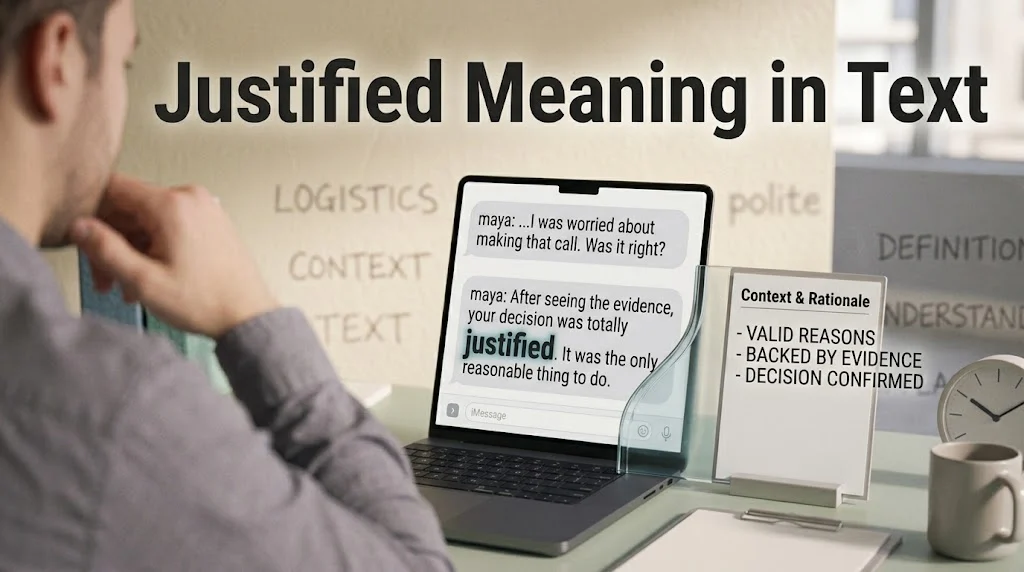
In everyday texting, justified usually means having a good reason for something or being reasonable in what you did, said, or felt.
For example:
“You were justified in being upset.”
This means the person believes you had a valid reason to be upset.
Another example is:
“I think she was justified in leaving.”
Here, “justified” means her decision to leave was understandable or reasonable based on the situation.
The word can also describe an opinion, reaction, complaint, punishment, decision, or action.
Is “justified” slang?
No. Justified is not normally slang, an acronym, or an abbreviation.
It is a standard English word. It comes from the verb justify, which means to give a good reason for something or show that something is reasonable or correct.
That is an important difference from texting terms such as IDK, IDC, or BRB. Those are abbreviations commonly used online. “Justified” is simply an ordinary word that people may use in casual digital conversations.
What does justified mean in everyday chat?
In everyday chat, “justified” often means:
- You had a valid reason.
- Your reaction made sense.
- Your decision was reasonable.
- Your feelings were understandable.
- Something was deserved or warranted.
For example:
“You were justified for blocking him.”
This means the speaker believes you had a good enough reason to block him.
However, context matters. If someone says:
“The paragraph is justified.”
they may be talking about text formatting, not someone having a good reason.
What does justified mean in writing?
In documents, justified text has a completely different practical meaning.
When text is justified, the lines are arranged so that they generally reach both the left and right margins. A word processor adjusts the spacing between words to create an even edge on both sides.
You may see this option in Microsoft Word, Google Docs, Canva, publishing software, or other writing tools.
For example, a document editor may give you four alignment choices:
- Left aligned
- Center aligned
- Right aligned
- Justified
So if your teacher says, “Make the essay justified,” they probably mean to change the paragraph alignment rather than saying your argument is reasonable.
Where People Use “Justified”
Because “justified” is a normal English word rather than a specific piece of slang, it can appear in many different places.
The meaning usually becomes clear from the surrounding words.
TikTok
On TikTok, people may use “justified” when discussing whether someone’s behavior was reasonable.
For example:
“Honestly, she was justified for calling him out.”
The commenter is saying that they believe her reaction was understandable.
You might also see the word in videos about arguments, relationships, social situations, or controversial opinions.
Someone might ask:
“Was I justified?”
That usually means:
“Was I right or reasonable for doing this?”
It does not necessarily mean the person is definitely correct. It is often asking other people to judge the situation.
Snapchat
On Snapchat, “justified” can appear in ordinary conversations between friends.
For example:
“You were justified 😂 I would’ve done the same.”
The person is agreeing that their friend’s reaction was reasonable.
Because Snapchat conversations are usually informal, people may use the word casually without thinking about its formal dictionary definition.
On Instagram, “justified” often appears in comments or captions when people are discussing someone’s behavior.
For example:
“Her reaction was completely justified.”
This means the commenter believes the reaction was appropriate given what happened.
It can also appear in discussions about celebrities, relationships, social issues, or arguments.
On WhatsApp, the word can be used just like it would be in a normal conversation.
A friend might message:
“I think you were justified.”
That generally means:
“I think you had a good reason.”
WhatsApp is also commonly used for school and workplace communication, so “justified” can have its formatting meaning there too.
For example:
“Please send the report with justified paragraphs.”
In that situation, the sender is talking about document formatting.
SMS and regular texting
In SMS messages, “justified” is usually used in its ordinary English sense.
Someone might text:
“Was I justified in saying that?”
They are asking whether their words or behavior were reasonable.
There is no special texting abbreviation hidden inside the word. It is simply the standard word justified.
Real Chat Examples
The following examples show how “justified” can naturally appear in conversations.
Example 1: Being upset
A:
He cancelled on me again.
B:
Honestly, you were justified in being annoyed.
A:
Yeah, I just wish he’d told me earlier.
Here, “justified” means A had a reasonable reason to be annoyed.
Example 2: Blocking someone
A:
I blocked him after he kept sending rude messages.
B:
I think you were justified.
A:
I didn’t want to keep arguing with him.
Here, B believes blocking the person was reasonable.
Example 3: Asking for an opinion
A:
Do you think I was justified for leaving?
B:
After what happened, yeah.
A:
That’s what I thought too.
Here, “justified” means “was my decision reasonable?”
Example 4: Defending a friend
A:
Everyone says Mia overreacted.
B:
I don’t think she did.
A:
Same. I think she was justified.
The speaker believes Mia had a good reason for her reaction.
Example 5: A disagreement
A:
I told my brother to stop borrowing my stuff.
B:
Were you justified?
A:
I think so. He never asks first.
Here, B is asking whether the speaker’s reaction was reasonable.
Example 6: Workplace situation
A:
My manager rejected the request.
B:
Was there a reason?
A:
Yeah, apparently the deadline was too close.
B:
Then the decision was probably justified.
In this case, “justified” means the decision had a reasonable basis.
Example 7: School
A:
The teacher gave him extra time because his computer crashed.
B:
That seems justified.
A:
Yeah, he showed her what happened.
Here, the speaker thinks the teacher’s decision was fair.
Example 8: Social media argument
A:
She posted the whole story after they argued.
B:
Was that justified?
A:
I don’t know. Maybe not.
This shows that “justified” can be used when someone is deciding whether another person’s behavior was appropriate.
Example 9: Casual agreement
A:
I left the group chat. It was getting toxic.
B:
Honestly, justified 😂
A:
I needed the peace.
The word is being used casually to show agreement.
Example 10: Text formatting
A:
Can you fix the formatting on my essay?
B:
Sure. What needs changing?
A:
The paragraphs need to be justified.
B:
Got it. I’ll change the alignment.
This is a completely different use of the word. Here, “justified” refers to document formatting.
How to Reply When Someone Says “Justified”
If someone tells you that your actions were “justified,” they are usually agreeing with you or supporting your decision.
Your reply can depend on the tone of the conversation.
Funny replies
If the conversation is playful, you could say:
- “I knew you’d understand 😂”
- “Finally, someone on my side.”
- “Exactly. Case closed.”
- “Thank you for confirming my innocence 😂”
- “The jury has spoken.”
These responses work best with friends who understand the joke.
Casual replies
For an ordinary conversation, you could respond:
- “Yeah, I think so too.”
- “That’s what I thought.”
- “Exactly.”
- “I just didn’t see another option.”
- “I agree.”
These keep the conversation relaxed.
Friendly replies
If someone is supporting you, you might say:
- “Thanks, I appreciate that.”
- “That actually makes me feel better.”
- “Thanks for understanding.”
- “I’m glad you see where I’m coming from.”
These are useful when the conversation is more personal.
Neutral replies
If you don’t want to strongly agree or disagree, try:
- “I understand what you mean.”
- “Maybe. It was a difficult situation.”
- “I can see why you think that.”
- “I wasn’t sure myself.”
- “It probably depends on how you look at it.”
These replies are useful when the situation is complicated.
Is “Justified” Rude or Offensive?
No, “justified” is not inherently rude or offensive.
It is a normal English word and is generally safe to use in everyday conversation.
The tone depends on how you use it.
For example:
“You were justified in being upset.”
sounds supportive.
But:
“You think you’re justified in treating people like that?”
can sound challenging or critical.
The word itself is not offensive. The surrounding statement determines whether the message feels friendly, neutral, or confrontational.
Is it safe to use at school?
Yes.
“Justified” is perfectly appropriate for schoolwork and academic writing.
For example:
“The character’s decision was justified because she had evidence of the problem.”
You may also see “justified” used when teachers discuss formatting.
Is it safe to use at work?
Yes.
It is also appropriate in professional communication.
For example:
“The additional expense was justified by the project’s requirements.”
That said, if you’re writing professionally, make sure you are using the word precisely. Calling someone’s behavior “justified” can sometimes sound like you’re making a strong judgment about the situation.
Who Uses This Term?
Because “justified” is standard English, it is not limited to a particular age group.
Teenagers, young adults, older adults, teachers, professionals, writers, and journalists can all use it.
Gen Z usage
Gen Z may use “justified” in casual online conversations, especially when discussing arguments or social situations.
For example:
“Honestly, she’s justified.”
This can be a quick way of saying:
“I think her reaction makes sense.”
However, it is important not to confuse this with a Gen Z-specific slang term. The word itself existed long before social media.
Common platforms
You can find “justified” on almost any platform where people communicate, including:
- TikTok
- Snapchat
- Discord
- X
- SMS
- Online forums
Its frequency and meaning depend heavily on the topic.
Someone discussing a relationship might use it to talk about whether a reaction was reasonable. Someone discussing graphic design might use it to describe text alignment.
How often does it appear online?
The word is fairly common in general English, but it is not a special texting abbreviation that appears in every chat.
You are much more likely to see abbreviations such as “IDK” or “BRB” in casual messaging.
“Justified” tends to appear when someone is explaining, defending, or judging a decision, action, reaction, or opinion.
Origin of the Term
The word justified comes from the much older word justify.
The English verb “justify” developed through French and Latin roots connected with the idea of making something right, lawful, or reasonable.
So the modern meaning did not originate on TikTok, Snapchat, or another social media platform.
This is important because people sometimes assume that any word frequently seen online must be internet slang. That is not the case here.
Internet culture and “justified”
Although the word itself is old, the internet has made one particular use very visible: people publicly debating whether someone’s actions were justified.
Social media encourages people to share stories and ask strangers for opinions.
For example:
“Was I justified for blocking my friend?”
or:
“Was I wrong for leaving?”
Comments may then include responses such as:
“You were justified.”
This type of discussion has become especially common on social platforms and online communities.
The internet did not create the word. Instead, it helped popularize situations where people use the word to judge behavior.
Is the origin certain?
Yes, the word itself has a well-established historical origin, so it would be inaccurate to describe “justified” as slang that suddenly appeared online.
What can vary is the popularity of particular casual uses.
For example, the short online response “justified” may feel more conversational than the same word used in a formal essay, but the underlying meaning remains the same.
“Justified” Compared With Other Texting Terms
It can help to compare “justified” with common texting abbreviations.
| Term | Meaning | Type | Usage | Popularity |
|---|---|---|---|---|
| Justified | Reasonable, valid, or supported by a good reason | Standard English word | Conversations, social media, writing, school, work | Common |
| IDK | I don’t know | Abbreviation | Texting, chats, social media | Very common |
| IDC | I don’t care | Abbreviation | Casual texting and social media | Very common |
| IMO | In my opinion | Abbreviation | Texting, comments, online discussions | Common |
| BRB | Be right back | Abbreviation | Texting and online chats | Common |
The biggest difference is that “justified” is not a texting abbreviation.
If someone writes “IDK,” they are shortening “I don’t know.”
If someone writes “IMO,” they are shortening “in my opinion.”
But if someone writes “justified,” they are using the complete English word.
Real-World Usage Example
Imagine that two friends are talking after school.
One friend had agreed to meet someone at 5:00 p.m. The other person repeatedly arrived late without explaining what was happening. After waiting for a long time, the first friend decided to leave.
Later, they tell another friend:
“I left because he’d already been late three times.”
The friend might respond:
“Honestly, you were justified.”
What does that mean?
It means the friend believes leaving was reasonable given the circumstances.
Notice that “justified” does not necessarily mean that everyone would make exactly the same choice. It simply expresses the opinion that there was a good enough reason for the action.
Now consider a different situation.
A teacher tells a student:
“Your essay needs to be justified.”
Here, the teacher is not saying the student’s essay is reasonable or correct.
They mean the paragraph alignment should be set to justified.
This is why context matters so much when interpreting the word.
The Two Main Meanings to Remember
If you see “justified” in a message, ask yourself what the conversation is about.
Meaning 1: Reasonable or valid
If someone is talking about behavior, feelings, arguments, or decisions, “justified” usually means:
“You had a good reason for doing that.”
Example:
“She was justified in being angry.”
Meaning 2: Text alignment
If someone is talking about Microsoft Word, Google Docs, essays, page design, or formatting, “justified” means:
“The text is aligned evenly along both margins.”
Example:
“Please use justified alignment for the report.”
These are the two meanings most people need to know.
Frequently Asked Questions
What does “justified” mean in text messages?
In text messages, “justified” usually means reasonable, valid, or having a good reason. For example, “You were justified” means the speaker thinks your actions or reaction made sense.
What does “justified” mean on TikTok?
On TikTok, “justified” is often used when people discuss whether someone’s behavior or reaction was reasonable. A comment such as “She was justified” means the commenter supports her actions.
Is “justified” slang?
No. “Justified” is a standard English word, not slang, an acronym, or a texting abbreviation. Social media users may use it casually, but the word itself is much older than the internet.
Is “justified” rude or offensive?
No. The word is not inherently rude or offensive. However, saying someone was or was not justified can sound judgmental depending on the situation and tone.
How should you reply to “justified”?
If someone says your actions were justified, you can reply casually with “Exactly,” “Thanks for understanding,” or “That’s what I thought too.” For a more neutral response, try “I understand what you mean.”
Final Takeaway
The meaning of “justified” depends on context, but it is usually easy to understand once you know the two main uses. In everyday texting and social media conversations, justified usually means that someone had a reasonable or valid reason for what they did, said, or felt. If a friend says, “You were justified,” they are generally saying, “I think your reaction made sense.”
In documents, however, justified refers to text alignment. A justified paragraph is arranged so that its lines line up with both the left and right margins. The word is not slang or an abbreviation, even though you may see it frequently in online conversations. It is a standard English word that people use in both casual and formal settings.
If you’re talking with friends, using “justified” is completely normal. At school or work, it is also appropriate. Just pay attention to context, especially when someone is talking about formatting rather than someone’s behavior.
The simplest way to remember it is: Justified reasonable or supported by a good reason. And when you’re talking about documents:
Discover more post
What Does ofn Mean in Text? 2026
What Does skl Mean in Text? 2026
What Does ukw mean in text? 2026

Mia is a passionate humor writer and wordplay specialist at MeanlyGuru. She creates clean, clever, and shareable puns, jokes, and light-hearted content designed for global readers. Her writing style is simple, smart, and highly engaging—perfect for social media, daily laughs, and modern digital audiences.