
If you have seen someone reply “well said” in a text, comment, group chat, or social media post, you may wonder exactly what they mean. The phrase is simple, but its meaning can depend on the situation. Most of the time, “well said” is a positive response. It means the person believes you expressed an idea clearly, accurately, thoughtfully, or in a convincing way.
For example, imagine someone posts: “You do not always need to agree with someone to respect their opinion.” Another person might reply: “Well said.” In this case, they are essentially saying, “I agree with what you said, and you expressed it very well.”
The expression can also be used in conversations, emails, text messages, online discussions, speeches, and social media comments. Sometimes it is sincere praise. In other situations, it can be slightly sarcastic, depending on the tone and context. This guide explains what “well said” means, how people use it in texts and online conversations, whether it means “I agree,” and how to respond when someone says it to you.
What Does “Well Said” Mean?
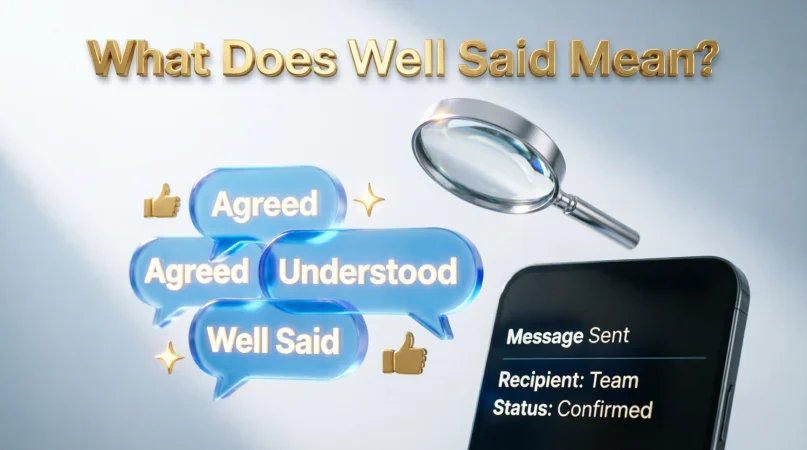
“Well said” means that someone has expressed an idea, opinion, feeling, or argument in a clear, effective, or appropriate way.
It is generally a compliment.
When someone tells you “well said,” they may mean:
- “You explained that clearly.”
- “I agree with your point.”
- “You expressed what I was thinking.”
- “That is a good way to put it.”
- “You made a strong argument.”
- “Your words were thoughtful.”
- “You said exactly what needed to be said.”
The exact meaning depends on the conversation.
For example:
Person A: “Making a mistake does not mean you have failed. It means you have something to learn.”
Person B: “Well said.”
Here, Person B probably likes both the message and the way it was expressed.
The phrase does not necessarily mean that the speaker agrees with every single detail. Sometimes someone can appreciate how clearly an argument was presented without completely agreeing with it.
That distinction is useful when interpreting comments online.
Is “Well Said” a Compliment?
Yes. In normal conversation, “well said” is a compliment.
When someone says it to you, they are usually acknowledging that your words were meaningful, clear, persuasive, or well chosen.
It can be similar to saying:
“Good point.”
However, the two expressions are not exactly identical.
“Good point” usually focuses on the idea itself. “Well said” puts more emphasis on how effectively the idea was expressed.
Compare these examples:
“Good point. We should consider the cost before making a decision.”
This means the speaker thinks the argument is valid.
“Well said. We should consider the cost before making a decision.”
This suggests the speaker thinks the statement was expressed particularly well.
Of course, people often use the two phrases interchangeably in casual conversation.
What Does “Well Said” Mean in Text Messages?
In texting, “well said” usually means “I like how you expressed that” or “I agree with what you said.”
Text messages are often short, so the phrase can carry quite a bit of meaning in just two words.
For example:
You: “Sometimes protecting your peace means saying no, even when people expect you to say yes.”
Friend: “Well said.”
Your friend is probably complimenting your thought and agreeing with the sentiment.
Another example:
You: “We should judge people by their actions rather than by rumors.”
Friend: “Well said.”
This is a simple way of showing approval without writing a long response.
Why do people use it in texts?
A person may use “well said” because they want to acknowledge your message without repeating the entire idea.
It can communicate:
- agreement
- appreciation
- encouragement
- respect
- admiration
- acknowledgment
Sometimes a longer response is unnecessary. If someone has already made a strong point, “well said” can be enough.
Does “Well Said” Mean “I Agree”?
Usually, but not always.
This is one of the most important things to understand about the expression.
When someone says “well said,” they often agree with the statement. However, the literal meaning is closer to “That was expressed well” than simply “I agree.”
For example:
Person A: “Everyone should have the freedom to make their own career choices.”
Person B: “Well said.”
Person B probably agrees.
But imagine a debate:
Person A: “I understand why some people support this policy, because the goal is to reduce costs.”
Person B: “Well said. I still disagree with the policy, though.”
Here, “well said” means Person B respects the way the argument was presented, even though they do not agree with the conclusion.
So if you receive “well said,” it is generally positive, but you should look at the surrounding conversation before assuming complete agreement.
“Well Said” Meaning on Social Media
On social media, “well said” is commonly used as a quick comment of approval.
You might see it under:
- motivational posts
- opinions
- political discussions
- relationship advice
- personal stories
- inspirational quotes
- serious discussions
- educational posts
- thoughtful observations
For example, someone might post:
“You can miss someone and still know that leaving was the right decision.”
A follower might comment:
“Well said.”
In this context, the commenter is expressing appreciation for the message.
Another person might write:
“Success is not always about getting more. Sometimes it is about learning to appreciate what you already have.”
Someone replies:
“Well said!”
The exclamation mark makes the response feel slightly more enthusiastic, although even “well said” without punctuation can be warm and positive.
“Well Said” on Instagram, TikTok, Facebook, and X
The basic meaning remains the same across different platforms.
On Instagram, it might appear under an inspirational caption.
On TikTok, someone might comment “well said” after a creator explains an opinion or personal experience.
On Facebook, it is common under longer posts where someone has shared a personal thought or argument.
On X, people may use it when responding to a concise statement, opinion, or commentary.
The platform does not fundamentally change the definition. The surrounding content and tone matter more than the app itself.
Because social media communication is often brief, “well said” is useful when someone wants to show support without writing a detailed reply.
What Is the Difference Between “Well Said” and “Well Done”?
These expressions are related, but they are used differently.
“Well said” is normally used when someone has expressed an idea, statement, or opinion effectively.
“Well done” is broader. It usually praises someone for completing an action successfully.
For example:
“You handled that difficult conversation professionally. Well done.”
That praises an action.
But:
“You explained the situation clearly and fairly. Well said.”
That praises the person’s words.
Think of it this way:
Well said = You expressed that effectively.
Well done = You performed or completed that successfully.
There are situations where both can work, but they emphasize different things.
What Is the Difference Between “Well Said” and “Good Point”?
These phrases are close, but they are not exactly the same.
“Good point” usually means the speaker thinks your argument or observation is valid.
“Well said” focuses more on your wording and presentation.
Consider this:
“We should not buy the cheapest option if replacing it twice will cost more in the long run.”
Someone might say:
“Good point.”
They are agreeing that your reasoning makes sense.
They might instead say:
“Well said.”
That suggests they appreciate the way you communicated the idea.
In everyday texting, however, people do not always make such a careful distinction. Either phrase can simply be a quick way to show approval.
What Is the Difference Between “Well Said” and “Exactly”?
“Exactly” is usually a stronger and more direct expression of agreement.
If someone says:
“People often remember how you treated them more than what you told them.”
And you respond:
“Exactly.”
You are saying you strongly agree.
If you respond:
“Well said.”
You are praising the statement and probably agreeing with it.
You could even combine them:
“Exactly. Well said.”
This sounds like strong approval.
Can “Well Said” Be Sarcastic?
Yes.
Although “well said” is normally sincere and positive, tone can completely change its meaning.
In face-to-face conversation, sarcasm may be obvious because of someone’s voice, facial expression, or body language.
Text is different.
Suppose someone makes an obviously unreasonable statement and another person replies:
“Well said.”
That could be genuine, but it could also be sarcastic.
For example:
Person A: “I ignored everyone’s advice and now everything went wrong.”
Person B: “Well said.”
Depending on the conversation, Person B could genuinely be encouraging Person A, or they could be making fun of the situation.
Look for clues such as:
- unusual punctuation
- emojis
- the previous messages
- the relationship between the people
- whether the statement was obviously exaggerated
- words like “sure” or “right”
- the general mood of the conversation
A sarcastic “well said” often feels different from a sincere one.
For example:
“Wow, well said 🙄”
The eye-roll emoji makes the sarcastic tone much clearer.
Without context, however, it is difficult to know someone’s intention from two words alone.
Is “Well Said” Formal or Informal?
“Well said” works in both formal and informal situations.
It is common in casual conversations, but it is not slang.
You can use it with:
- friends
- family
- coworkers
- teachers
- classmates
- online communities
- professional contacts
For example, during a business meeting, someone might say:
“Well said. I think that is an important concern.”
That sounds professional and natural.
In a group chat, someone might simply write:
“Well said!”
That is casual.
The phrase itself is flexible enough to fit many situations.
Can You Say “Well Said” to Someone You Don’t Know?
Yes.
It is perfectly normal to say “well said” to someone whose post or comment you appreciate, even if you have never met them.
This is especially common online.
For example, if someone writes a thoughtful comment in a public discussion, you could respond:
“Well said. I hadn’t thought about it that way.”
This is polite and respectful.
If you want to sound a little more personal, you can add a sentence explaining what you liked:
“Well said. I especially agree with your point about giving people a second chance.”
That gives the person more information than a simple two-word response.
How to Respond When Someone Says “Well Said”
If someone tells you “well said,” you do not need to give a complicated answer.
A simple response is perfectly acceptable.
You could say:
- “Thank you!”
- “Thanks, I appreciate that.”
- “Glad you agree.”
- “Thank you. I really meant it.”
- “I appreciate that.”
- “Exactly.”
- “Thanks! That was my thought too.”
The best response depends on the situation.
If you want to be casual
“Thanks!”
or:
“Appreciate it!”
If the conversation is serious
“Thank you. I think it’s an important point.”
If you want to continue the discussion
“Thanks. I’d be interested to hear what you think about the rest of it.”
If the person agrees with you
“Thanks! I’m glad you see it that way too.”
There is no special rule requiring a particular response.
Examples of “Well Said” in Different Situations
Understanding examples is often easier than memorizing a definition.
Example 1: Friendship
Friend 1: “Real friends do not have to talk every day. The connection can still be there.”
Friend 2: “Well said.”
Here, the second friend agrees with and appreciates the observation.
Example 2: Work
Employee: “I think we should solve the underlying problem instead of continuing to fix the same issue every week.”
Manager: “Well said.”
Here, the manager is complimenting the employee’s reasoning and communication.
Example 3: Relationship Advice
Person A: “A healthy relationship should give you room to be yourself.”
Person B: “Well said.”
This is an expression of approval.
Example 4: Social Media
Poster: “Not every opportunity is worth accepting. Sometimes saying no gives you the time to focus on what actually matters.”
Comment: “Well said.”
The commenter likes the message.
Example 5: Debate
Person A: “I understand the benefits of the proposal, but I am concerned about how it would affect smaller businesses.”
Person B: “Well said. I have a different conclusion, but that is an important concern.”
Here, the phrase acknowledges the quality of the argument without necessarily expressing full agreement.
Example 6: Sarcasm
Person A: “I definitely did not procrastinate. I simply waited until the last possible moment to begin.”
Person B: “Well said 😂”
This could be playful or sarcastic, especially because the statement is humorous.
What Does “Very Well Said” Mean?
“Very well said” is simply a stronger version of “well said.”
It suggests that the person particularly liked the way something was expressed.
For example:
“Very well said. I think that is something many people forget.”
This can sound more enthusiastic and thoughtful than a simple “well said.”
You may also see:
“So well said.”
This is common online and usually has a warm, emotional tone.
For example:
“So well said. This really needed to be heard.”
The meaning is still essentially the same: the speaker thinks the message was expressed very effectively.
What Does “Nicely Said” Mean?
“Nicely said” is another variation.
It usually means:
“That was a good way to express your thought.”
It can sound slightly softer or more casual than “well said.”
For example:
“Nicely said. I completely understand what you mean.”
Again, the context determines how strongly the person agrees.
Why Do People Say “Well Said” Instead of Writing More?
Sometimes a person has already expressed an idea so clearly that there is not much more to add.
Imagine reading a long post that explains something you strongly agree with. Instead of writing another paragraph repeating the same points, you might simply comment:
“Well said.”
This can be a way of saying:
“You put into words what I was thinking.”
That is one reason the phrase appears frequently in online discussions.
It is short, positive, and easy to understand.
Does “Well Said” Mean They Respect You?
Often, yes.
When someone says “well said” sincerely, they are usually showing some level of respect for your ability to communicate.
That does not necessarily mean they agree with your entire worldview. But they are acknowledging that your statement was thoughtful, clear, persuasive, or appropriate.
For example:
“I don’t completely agree with you, but that was well said.”
This makes the distinction especially clear.
The person disagrees with the conclusion but respects the way you presented your position.
Is “Well Said” a Good Reply to an Emotional Message?
It can be, but be careful.
If someone is sharing something deeply personal, “well said” may sometimes sound a little formal or detached.
For example:
Friend: “I’ve been struggling because I feel like I’m always trying to make everyone happy.”
Responding only:
“Well said.”
could sound less supportive than:
“I understand what you mean. You explained that really well, and I’m sorry you’re feeling that way.”
In emotional conversations, context matters.
“Well said” works especially well when the person is making a thoughtful observation. But if they are sharing pain, fear, grief, or a personal problem, they may need empathy rather than just acknowledgment.
Is “Well Said” the Same as “You’re Right”?
Not necessarily.
“You’re right” directly tells someone that their statement is correct.
“Well said” tells them that their statement was expressed effectively.
There is overlap, but the emphasis is different.
For example:
“You’re right. We should have checked the schedule first.”
This is a direct admission that the person is correct.
Compare:
“Well said. We should have checked the schedule first.”
This sounds like appreciation for the way the person made the point.
In casual conversations, people may use either phrase without thinking about the distinction.
Common Situations Where “Well Said” Fits Naturally
You can use the expression when someone:
- Makes a thoughtful observation.
- Explains a complicated idea clearly.
- Gives useful advice.
- Makes a persuasive argument.
- Shares an inspirational thought.
- Summarizes something accurately.
- Expresses a feeling you understand.
- Makes a strong point during a discussion.
- Writes a meaningful social media caption.
- Says something that captures your own thoughts.
For example:
“You don’t need to have everything figured out before taking the first step.”
A natural response would be:
“Well said.”
Another:
“Being busy does not always mean being productive.”
Response:
“Very well said.”
These examples show why the phrase is so useful: it acknowledges the quality of someone’s words without requiring a long reply.
When Should You Avoid Saying “Well Said”?
There are a few situations where another response may be more appropriate.
If someone is asking you a direct question, “well said” may not answer it.
For example:
Person: “Are you coming to dinner tonight?”
You: “Well said.”
That would be confusing.
Similarly, if someone is telling you about a serious personal problem, a simple “well said” might feel impersonal.
If someone says:
“I’m really worried about losing my job.”
A better response might be:
“I’m sorry you’re dealing with that. Is there anything I can do to help?”
The phrase is best used when the person has said something, rather than when they are simply asking for information or support.
“Well Said” in Online Arguments
Online arguments are one place where the expression appears frequently.
Someone may write a detailed comment explaining their position. Another user may respond:
“Well said.”
This can mean they support the argument.
However, online discussions can also make sarcasm difficult to identify.
For instance:
“Well said, professor.”
might be sincere, playful, or insulting depending on the conversation.
The safest approach is to consider the whole exchange rather than interpreting the two words by themselves.
If you are unsure whether someone is being sincere, look at their other comments and the punctuation or emojis they use.
Why Context Matters So Much
Words rarely have meaning completely independent of context.
“Well said” is a good example.
In one conversation:
“Well said! I couldn’t agree more.”
Clearly expresses strong agreement.
In another:
“Well said, but I don’t think that’s the whole story.”
This expresses appreciation for the wording while introducing disagreement.
And:
“Well said 🙄”
could be sarcastic.
The phrase itself remains the same. The surrounding words change its meaning.
This is particularly important in text messages because written communication does not include voice tone or facial expressions.
Short Answers You Can Use Instead of “Well Said”
If you want to express the same basic idea, there are plenty of alternatives.
Casual alternatives
- “Good point.”
- “Exactly.”
- “So true.”
- “I agree.”
- “Absolutely.”
- “You said it perfectly.”
- “That’s a great way to put it.”
- “Couldn’t have said it better myself.”
More enthusiastic alternatives
- “Very well said!”
- “So well said!”
- “That’s exactly right.”
- “You put it perfectly.”
- “I completely agree.”
More professional alternatives
- “That’s a thoughtful way to put it.”
- “You make a strong point.”
- “That is clearly expressed.”
- “I think you summarized the issue very well.”
Choosing between these depends on your relationship with the person and the tone of the conversation.
Frequently Asked Questions
What is the simple meaning of “well said”?
“Well said” means you expressed your idea, opinion, or message very well. It is usually a compliment and often implies agreement.
Is “well said” positive or negative?
It is normally positive. It shows approval or appreciation. However, it can be sarcastic if the context suggests that the person is not being sincere.
Does “well said” mean “I agree”?
Often, yes, but not always. It can mean that someone appreciates how clearly you expressed an idea even if they do not completely agree with it.
What does “well said” mean from a girl?
The phrase does not have a special meaning simply because a girl says it. In most situations, it means she thinks you expressed something well. The exact intention depends on the conversation and relationship.
What does “well said” mean from a guy?
The same basic rule applies. A guy saying “well said” is generally complimenting the statement or showing agreement.
Is “well said” formal?
It can be either formal or informal. It is appropriate in everyday conversations, online comments, workplace discussions, and more serious settings.
How do you respond to “well said”?
A simple “Thank you!” is enough. You can also say “I appreciate that,” “Glad you agree,” or continue the conversation if you want to discuss the subject further.
Can “well said” be sarcastic?
Yes. Tone and context can turn it into sarcasm. In text, emojis, punctuation, and the surrounding conversation can provide clues.
What is another way to say “well said”?
You can say “good point,” “exactly,” “nicely said,” “very well put,” “you said it perfectly,” or “couldn’t have said it better myself.”
Is “well said” slang?
No. “Well said” is a standard English expression rather than internet slang. It has been used in spoken and written English for a long time.
Final Takeaway
The simplest explanation of “well said” is: Someone is telling you that you expressed your thought, opinion, or feeling effectively. In text messages and social media comments, it is usually a quick way to show appreciation or agreement.
If someone responds to your post with “well said,” they are generally saying something like: “That was a good way to put it.” “I agree with that.” “You expressed what I was thinking.” The phrase can be used in casual chats, professional conversations, online discussions, and social media. It is usually positive, although context can sometimes make it sarcastic. If you are unsure how to respond, “Thank you!” is almost always a safe and natural choice.
The important thing is not to overthink the phrase. In most everyday situations, when someone says “well said,” they are simply giving you a small compliment and letting you know that your words made an impression.
Discover more post
What Does girthy meaning Mean in Text? 2026
What Does eau de parfum meaning Mean in Text? 2026
What Does athena name meaning Mean in Text? 2026