Have you ever received a message that simply says “what’s good?” and wondered what the other person actually means? Maybe a friend sent it on Snapchat, someone you like opened a conversation with it, or a person you have not spoken to in a while texted you those two words out of nowhere.
The good news is that “what’s good?” is usually a friendly, casual way to say hello, ask how someone is doing, or find out what is happening in their life. It is similar to saying “What’s up?”, “How are you?”, or “What’s going on?”
However, the meaning can change depending on who sends the message, the conversation you are having, and the tone behind it. Sometimes, it is simply a greeting. Other times, it can be a way to flirt, make plans, check in with a friend, or start a conversation without making things awkward.
In this guide, you will learn what “what’s good” means in text messages, how people use it on social media, what it means when someone you like sends it, and how to reply naturally. You will also see real-life examples that make the expression easy to understand, even if you are new to internet slang.
What Does “What’s Good” Mean in Text?
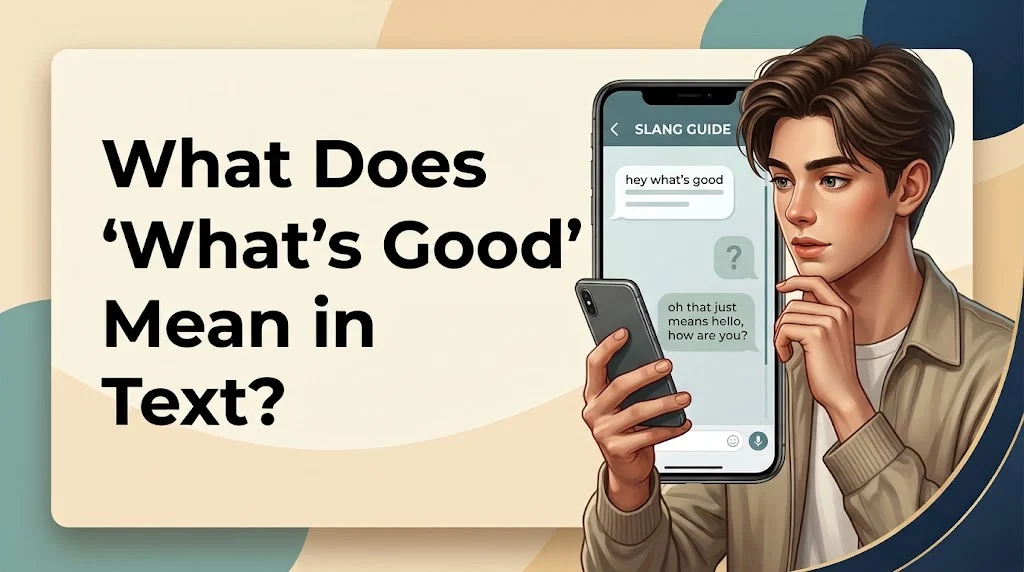
In texting, “what’s good?” is an informal greeting that usually means “What’s up?”, “How are you?”, or “What’s happening?” It is a relaxed way to start a conversation or ask someone what they are doing.
For example, imagine you are relaxing at home when a friend sends you this message:
Friend: What’s good?
You: Not much, just watching a movie. You?
In this exchange, your friend is probably not asking you to name something good. They are simply checking in and giving you an opportunity to talk.
The phrase is common in casual conversations between friends, classmates, coworkers who know each other well, and people who communicate through social media. It often sounds relaxed, friendly, and confident.
Depending on the situation, “what’s good?” can have several meanings:
- A casual hello: The person is greeting you.
- A check-in: They want to know how you are doing.
- A conversation starter: They want to talk but do not have a specific topic.
- A question about your plans: They may be asking what you are doing or whether you are available.
- A friendly invitation: They might be opening the door to making plans together.
The important thing to remember is that the phrase does not have one fixed meaning in every conversation. Most of the time, it is a simple greeting, but the surrounding messages can tell you more about the sender’s intention.
Where Does the Phrase “What’s Good?” Come From?
“What’s good?” is part of informal spoken English and conversational slang. It has been used in casual speech for years, particularly in American English and in many communities where relaxed greetings are part of everyday conversation.
It is closely related to expressions such as “What’s up?”, “What’s happening?”, and “What’s going on?” Over time, the phrase became familiar in music, movies, everyday conversations, and online communication.
As texting and social media became part of daily life, people began using short, conversational expressions to start messages. “What’s good?” fits naturally into that style because it is quick to type and does not require a formal response.
Today, you might see it in text messages, Instagram direct messages, Snapchat chats, TikTok comments, gaming conversations, and group chats.
It is worth remembering that slang varies by region, age group, and social circle. Some people use “what’s good?” every day, while others prefer “what’s up?” or “you good?” The expression is widely understandable, but it may sound more natural in some communities than in others.
There is no need to memorize a complicated history to understand the phrase. In everyday texting, its main purpose is to open a conversation in a relaxed way.
What Does “What’s Good?” Mean on Social Media?
On social media, “what’s good?” usually carries the same meaning it has in text messages. The difference is that the platform and the type of interaction can influence how you interpret it.
Here is how it commonly appears on different platforms.
What Does “What’s Good?” Mean on Snapchat?
On Snapchat, someone may send “what’s good?” to start a chat, respond to your story, or reconnect after a period of silence.
For example:
Them: What’s good?
You: Just chilling. What about you?
Them: Same. What are you up to later?
Here, the first message is a casual opening. The other person may simply want to talk, or they may be working toward making plans.
If someone sends the phrase after viewing your Snapchat story, they might be responding to something they saw. If you posted a picture from a concert, for example, they could be using the greeting to start a conversation about your night.
Still, one message alone does not prove that the person is interested in you romantically. Their follow-up questions and the overall conversation provide better clues.
What Does “What’s Good?” Mean on Instagram?
On Instagram, the phrase often appears in direct messages, especially when someone wants to begin talking without writing a long introduction.
Imagine someone you follow sends:
Them: Hey, what’s good?
You: Not much! Just scrolling. How’s your day going?
This is a normal, friendly exchange. The sender may be a friend, an acquaintance, or someone hoping to get to know you better.
If a person regularly replies to your stories, asks questions about your interests, and continues conversations, those actions may suggest that they want to build a connection. The greeting itself, however, is not enough to establish their intentions.
What Does “What’s Good?” Mean on TikTok?
On TikTok, you may encounter “what’s good?” in comments, direct messages, or conversations between creators and viewers.
In a comment section, it might be a friendly greeting or a way of engaging with someone. In a private message, it usually works as a casual conversation opener.
For instance:
Person A: What’s good?
Person B: Just found your page. Your videos are hilarious!
The greeting creates an opening for a more specific conversation.
As with other social platforms, context matters. A comment on a funny video may be playful, while a private message could be an attempt to get acquainted.
What Does “What’s Good?” Mean in a Group Chat?
In a group chat, “what’s good?” can mean “What is everyone doing?” or “What is happening?”
A friend might send it to see who is available to hang out. Someone else might use it to restart a quiet group conversation.
For example:
Alex: What’s good, everyone?
Sam: Nothing much.
Jordan: Anyone want to get food?
Here, the greeting helps bring people into the conversation. It does not necessarily require every person to give a detailed update.
Does “What’s Good?” Mean “How Are You?”
Yes, it often does.
When someone asks “what’s good?” in a friendly conversation, they may be checking on your general well-being. The question is usually less formal than “How are you doing?” and often invites a short, relaxed answer.
For example:
Them: What’s good?
You: Doing pretty well. Just taking it easy today.
Your response answers the general idea of the question without treating it as a request for a list of good things.
There is a small difference between the expressions, though.
“How are you?” directly asks about your condition or feelings. “What’s good?” can be broader. It may refer to your mood, your plans, recent events, or simply what is happening in your world.
For that reason, you can answer in several ways:
- “I’m good, thanks!”
- “Not much, just relaxing.”
- “Everything’s going well.”
- “Just working. What about you?”
- “Pretty good! How have you been?”
You do not need to give a serious personal update unless you want to. A brief answer is perfectly normal.
What Does It Mean When a Guy Says “What’s Good?”?
When a guy texts you “what’s good?”, he is usually starting a casual conversation. However, the meaning can depend on your relationship with him and what happens after you reply.
There are several possibilities.
1. He wants to talk to you.
He might be interested in having a conversation but unsure how to begin. Instead of sending a long message, he chooses a short, familiar greeting.
2. He is checking what you are doing.
If he follows up with questions such as “What are you doing tonight?” or “Are you free later?”, he may be trying to find out whether you are available to hang out.
3. He is flirting or showing interest.
If he compliments you, asks personal questions, remembers details about your life, or consistently makes an effort to keep conversations going, he might be interested in getting closer to you.
4. He is simply being friendly.
Not every greeting has a hidden meaning. Some people use “what’s good?” with almost everyone they know. It may be no more romantic than saying hello to a friend.
Here is an example:
Guy: What’s good?
You: Not much. What’s up?
Guy: I was thinking about you. How have you been?
In this example, his second message provides more information than the greeting alone. He is making the conversation more personal, although you would still need more context to know whether his interest is romantic.
The bottom line: Do not judge his intentions by two words alone. Pay attention to how he communicates with you over time.
What Does It Mean When a Girl Says “What’s Good?”
When a girl texts you “what’s good?”, it generally means the same thing: she is greeting you, checking in, or starting a conversation.
She might be a friend who wants to chat, someone who has not spoken to you recently, or a person who is interested in getting to know you.
For example:
Girl: What’s good?
You: Everything’s good. How about you?
Girl: I’m good! Haven’t talked to you in a while.
This exchange suggests that she wants to reconnect. Whether that interest is friendly or romantic depends on the wider relationship.
If she frequently initiates conversations, asks about your day, and makes plans to spend time with you, those are more meaningful signs of interest than the initial greeting.
On the other hand, if she sends “what’s good?” and the conversation stays brief, she may simply be saying hello.
The same principle applies regardless of gender: the phrase itself is neutral, and the context gives it meaning.
Does “What’s Good?” Mean Someone Is Flirting?
Sometimes, but not always.
“What’s good?” can be used as a flirtatious opener because it sounds casual and gives the other person an easy way to respond. It can be particularly common when someone wants to start talking without making their interest too obvious.
However, it is also an ordinary greeting between friends. That is why it helps to consider what happens next.
Here are a few examples.
Example 1: A friendly greeting
Them: What’s good?
You: Just watching TV.
Them: Nice, enjoy!
This is a short, friendly exchange. There is not much evidence of flirting.
Example 2: A potentially flirtatious conversation
Them: What’s good?
You: Just relaxing. You?
Them: Nothing much. I was hoping you’d be around.
This response could suggest that the person wants your attention or hopes to spend time with you. It is still not definitive proof of romantic interest.
Example 3: A conversation that leads to plans
Them: What’s good?
You: Just finished work.
Them: Perfect. Want to grab coffee?
Here, the greeting appears to be an introduction to a specific invitation.
The key distinction is that flirting usually becomes clearer through the entire interaction, not through one slang expression. Look for consistency, mutual interest, and direct communication rather than trying to decode every short message.
What Is the Difference Between “What’s Good?” and “What’s Up?”
Both phrases are informal greetings, and they can often be used interchangeably. The main difference is one of style and personal preference.
| Expression | Common meaning | Typical feeling |
|---|---|---|
| What’s good? | What’s happening? How are you? | Casual, relaxed |
| What’s up? | What are you doing? How are things? | Casual, widely used |
| How are you? | How are you feeling? | Neutral, sometimes more polite |
| What’s going on? | What is happening? | Casual or concerned, depending on context |
| How’s it going? | How are things? | Friendly, conversational |
| You good? | Are you okay? | Casual; can also show concern |
| What are you up to? | What are you doing? | Friendly, sometimes an invitation opener |
For example, a friend could send any of the following:
- “What’s good?”
- “What’s up?”
- “How’s it going?”
- “What are you up to?”
All four could be ways of starting a conversation.
There are situations where the meaning becomes more specific. If someone asks “You good?” after you seem upset, they may genuinely want to know whether you are okay. If they ask “What are you up to tonight?”, they may be interested in your plans.
“What’s good?” is generally more about opening the conversation than asking for a precise answer.
What Is the Difference Between “What’s Good?” and “What’s Good With You?”
These expressions are similar, but they can have slightly different conversational uses.
“What’s good?” is a short, general greeting. It may mean “What’s up?” or “What is happening?”
“What’s good with you?” usually directs the question more clearly toward the other person. It can mean “How have you been?” or “What is going on in your life?”
Consider these examples:
Message A: What’s good?
A natural response might be: “Not much, just chilling.”
Message B: Hey, what’s good with you?
A natural response might be: “I’m doing pretty well! Just busy with work lately. How about you?”
The second message may invite a slightly more personal answer, especially if the sender has not spoken to you for some time.
Still, these are flexible expressions. Friends may use them in exactly the same way, and the difference is not a strict grammatical rule.
How to Reply to “What’s Good?” in Text
The easiest way to respond is to treat it like a casual greeting. You do not need a clever answer, and you certainly do not have to explain everything happening in your life.
Choose a response that matches your personality and your relationship with the sender.
1. Casual Replies
If a friend or acquaintance sends the message, keep your answer simple.
Examples:
- “Not much, you?”
- “All good over here!”
- “Just chilling. What about you?”
- “Nothing much, how about yourself?”
- “Same old, same old.”
- “Doing good! What’s up?”
These responses acknowledge the greeting and give the other person a chance to continue the conversation.
2. Friendly Replies That Keep the Conversation Going
If you want to talk rather than end the exchange after one message, include a small detail or ask a follow-up question.
For example:
Them: What’s good?
You: Just got back from the gym. What are you up to?
Or:
Them: What’s good?
You: Pretty good! Been a busy week. How have you been?
These replies work because they offer something the other person can respond to. You are not just answering the greeting; you are creating an opportunity for a real conversation.
3. Flirty Replies
If someone you like sends “what’s good?”, you can respond playfully without making the interaction too intense.
Here are a few options:
- “Better now that you texted 😉”
- “Not much. Was hoping you’d message.”
- “Just thinking about what to do tonight. Any ideas?”
- “Everything’s good. What about you, trouble?”
- “Depends… are you asking because you miss me?”
These replies are more suggestive than a standard greeting. Use them when you already have a playful relationship and feel comfortable expressing interest.
If you are unsure whether the other person is flirting, start with something friendly. You can always make the conversation more playful if they respond in the same spirit.
4. Replies When You Want to Make Plans
Sometimes, the person may be asking about your availability without saying so directly.
If you suspect they want to hang out, or you want to suggest it yourself, try:
- “Not much. You trying to do something?”
- “Just finished work. What’s the plan?”
- “I’m free later. What’s up?”
- “Nothing planned yet. Got something in mind?”
- “Just relaxing. Want to grab something to eat?”
These answers make it easy to turn a general greeting into a specific plan.
Of course, you should not assume that every “what’s good?” is an invitation. You can simply respond and let the other person explain what they have in mind.
5. Replies When You Are Busy
You can still answer politely when you do not have time for a long conversation.
Try:
- “All good! Just busy right now. What’s up?”
- “Doing well, just working.”
- “Not much, but I’m a little tied up at the moment.”
- “Everything’s good. I’ll catch up with you later!”
- “Just handling a few things. You good?”
You do not need to ignore someone just because you are busy, but you also do not have to keep texting when you have other things to do.
6. Funny Replies
If you have a playful relationship with the sender, humor can make your answer more memorable.
Examples include:
- “The snacks in my kitchen.”
- “My weekend plans, hopefully.”
- “Absolutely nothing, and I plan to keep it that way.”
- “My bank account could be better.”
- “Peace, quiet, and a full night of sleep.”
These answers deliberately interpret “what’s good?” more literally or use it as an opportunity for a joke.
They work best when the other person understands your sense of humor. If you are speaking to someone you barely know, a straightforward greeting is usually the safer choice.
Real-Life Text Message Examples of “What’s Good?”
Sometimes, the easiest way to understand slang is to see how people use it in everyday conversations. Here are several realistic examples showing how the meaning changes with context.
Example 1: A Friend Checking In
Friend: What’s good?
You: Not much, just relaxing at home.
Friend: Nice. How was your day?
Meaning: Your friend is greeting you and starting a normal conversation. There is no special hidden meaning.
Example 2: Someone You Haven’t Spoken to in a While
Them: Hey, what’s good?
You: Hey! I’m doing well. It’s been a minute. How have you been?
Them: Pretty good, just busy with work.
Meaning: The person may be reconnecting after some time apart. Their message gives both of you a natural way to start talking again.
Example 3: Someone You Have a Crush On
Them: What’s good? 👀
You: Not much. What’s with the eyes? 😂
Them: Nothing, just wanted to talk to you.
Meaning: The emoji and follow-up make the interaction more playful and potentially flirtatious. However, you still need to consider your existing relationship.
Example 4: Making Weekend Plans
Friend: What’s good?
You: Just finished my errands. Why?
Friend: We’re going out later. You coming?
Meaning: The initial greeting opens the door to an invitation. In this case, the sender wants to make plans.
Example 5: A Conversation on Snapchat
Them: What’s good?
You: Just watching Netflix. Hbu?
Them: Same lol.
Meaning: Both people are casually sharing what they are doing. “Hbu” means “How about you?” and “lol” adds an informal tone.
Example 6: A Group Chat
Friend: What’s good, people?
You: Surviving Monday 😭
Another friend: Same. Anyone free this weekend?
Meaning: The greeting brings everyone into the conversation and can lead to jokes, updates, or plans.
Example 7: Someone Checking on You
Them: Hey, what’s good?
You: Nothing much. Why?
Them: Just checking in. Haven’t heard from you lately.
Meaning: The person is reaching out and may want to know how you are doing. Their follow-up makes the purpose of the message clearer.
Example 8: A Short Conversation That Goes Nowhere
Them: What’s good?
You: Not much, you?
Them: Same.
Meaning: This is a normal exchange, even if it does not lead anywhere. Sometimes people greet each other without having a particular topic in mind.
These examples show why you should not interpret every message in the same way. The phrase is flexible, and the messages around it provide the most useful clues.
Does Punctuation Change the Meaning?
Punctuation can affect the way a message feels, but it does not automatically change what the phrase means.
Here are some common variations.
“What’s good?”
This is the standard version. It sounds like a straightforward, casual greeting.
“What’s good”
Without a question mark, it still usually means the same thing. Many people leave out punctuation in text messages.
“Wsg?”
This is a shortened version commonly used in casual digital conversations. It generally means “What’s good?”
“What’s good??”
The extra question marks can suggest excitement, impatience, or a desire for a quick response. However, some people use multiple question marks without intending anything special.
“What’s good with you?”
This can sound more like a direct check-in about how someone is doing.
“Yo, what’s good?”
Adding “yo” makes the greeting sound especially casual and conversational.
Remember that texting has no reliable way to convey every aspect of spoken tone. The same words can sound warm, playful, impatient, or neutral depending on the person sending them and your existing relationship.
What Does “WSG” Mean in Text?
“WSG” is a common abbreviation for “what’s good?” It is used in casual messages, social media chats, gaming conversations, and other informal online interactions.
For example:
Friend: Wsg bro?
You: Nm, just chilling. Wbu?
Here is what the abbreviations mean:
- WSG: What’s good?
- NM: Not much.
- WBU: What about you?
- BRO: A casual way to address a friend or acquaintance.
The conversation means:
Friend: What’s good, bro?
You: Not much, just chilling. What about you?
Shortened expressions like these are popular because they save time and fit the quick, informal style of texting.
You may also see different spellings, such as “wassup,” “sup,” or “wsgg.” The exact spelling varies from person to person, and extra letters may be used for emphasis or a playful tone.
These abbreviations are generally best suited to casual conversations. In a professional email, formal message, or conversation with someone who expects standard language, writing out the full expression is usually more appropriate.
Is “What’s Good?” Rude or Disrespectful?
No. In most casual conversations, “what’s good?” is not rude or disrespectful. It is generally a friendly, informal greeting.
However, the way it is received depends on the situation.
Among friends, it can sound completely natural. Between strangers, it may feel a little too casual for some people. In a professional environment, it may not be the most appropriate way to address someone you do not know well.
Tone can also influence how a message feels.
For example:
“Hey, what’s good?”
This will usually sound friendly.
“What’s good with you?”
Depending on the situation, this may sound like a genuine question about how someone is doing.
“What’s your problem?”
This is a different expression entirely. It can sound confrontational and should not be confused with “what’s good?”
If someone sends you “what’s good?” without any other context, there is generally no reason to assume they are being disrespectful.
Likewise, if you want to use the phrase yourself, consider your audience. It is a natural choice for a friend, but a more polite greeting may work better when speaking with a manager, teacher, client, or someone you have just met.
Can “What’s Good?” Mean “What Do You Want?”
Sometimes, but this interpretation depends heavily on context.
In certain conversations, a person may use “what’s good?” to ask what someone wants, what they have in mind, or why they are reaching out.
For example:
Person A: Hey, can I ask you something?
Person B: Yeah, what’s good?
Here, Person B may mean “What is it?” or “What do you need?” rather than simply saying hello.
Similarly:
Friend: What’s good? You free tonight?
You: Maybe. What are you thinking?
In this case, the greeting leads into a question about plans.
The phrase can occasionally sound impatient if it is sent during an argument or after an unexpected message. But the words themselves do not automatically express annoyance.
If you are unsure what someone means, a simple reply such as “What’s up?” or “What did you have in mind?” can help clarify the conversation without creating unnecessary confusion.
Is “What’s Good?” Different From “You Good?”
Yes, although the expressions can overlap.
“What’s good?” is usually a general greeting. It can ask what is happening in someone’s life or simply serve as a way to start chatting.
“You good?” is often more directly connected to whether someone is okay. Depending on the situation, it can express concern, ask whether someone needs help, or check whether there is a problem.
Consider these examples.
Example A
Friend: What’s good?
You: Just playing video games.
This is an ordinary greeting followed by a casual update.
Example B
Friend: You good? You seemed upset earlier.
You: Yeah, I’m okay. Just had a rough day.
Here, the question is specifically about your well-being.
However, “you good?” can also be used casually between friends. Its meaning depends on the context just as much as “what’s good?” does.
Common Mistakes to Avoid When Interpreting “What’s Good?”
Although this phrase is simple, it is easy to read too much into a short text message.
Here are a few mistakes worth avoiding.
1. Assuming it always means flirting.
Someone may be interested in you, but the greeting alone does not prove romantic attraction. Look at the full conversation instead.
2. Thinking you must give a detailed answer.
A response such as “Not much, you?” is completely acceptable. You do not need to provide a long explanation of your day.
3. Assuming the sender is asking about something positive.
Although the word “good” appears in the phrase, people usually use it as a greeting rather than asking you to name something enjoyable.
4. Treating every punctuation mark as a hidden message.
An extra question mark or an emoji may add personality, but it is not reliable proof of someone’s feelings.
5. Assuming everyone uses the phrase in exactly the same way.
Slang can vary across cultures, regions, and social groups. The meaning that feels natural to one person may sound unusual to another.
6. Feeling pressured to reply in slang.
You can answer in ordinary English. If someone says “what’s good?”, replying with “I’m doing well, how about you?” is perfectly fine.
Understanding the general meaning is enough to participate comfortably in most conversations.
When Should You Use “What’s Good?” in a Text?
Use the phrase when you want to sound relaxed and approachable.
It works particularly well when messaging friends, reconnecting with acquaintances, starting a casual conversation, or checking whether someone is available to talk.
For example, you could send it to a friend you have not spoken to recently:
“Hey, what’s good? Haven’t caught up with you in a while.”
You could also use it to start a conversation with someone you already know:
“Yo, what’s good? You doing anything this weekend?”
Both messages are informal and give the other person an easy way to respond.
However, the phrase may not be the best choice for every situation. If you are contacting a new client, applying for a job, or writing to someone in a formal setting, a greeting such as “Hello, how are you?” will generally sound more appropriate.
The goal is not to use slang everywhere. It is to understand when it fits naturally.
Frequently Asked Questions
1. What does “what’s good” mean in simple words?
It usually means “What’s up?”, “How are you?”, or “What’s happening?” It is a casual greeting used to start a conversation or check in with someone.
2. What should I reply when someone texts “what’s good?”
You can reply with “Not much, you?”, “Just chilling,” “Everything’s good,” or “Doing well! What about you?” Choose a response that matches your mood and the relationship you have with the sender.
3. Does “what’s good?” mean the person likes me?
Not necessarily. It can be a way to start a conversation with someone they like, but it is also commonly used between friends. Their behavior throughout the conversation will tell you more.
4. What does “WSG” stand for?
WSG stands for “what’s good?” It is an informal abbreviation often used in text messages, social media chats, and online conversations.
5. Is “what’s good?” the same as “what’s up?”
In many situations, yes. Both expressions are casual greetings that can mean “How are you?” or “What’s happening?” The difference is mainly in personal preference and conversational style.
6. Can I reply “I’m good” to “what’s good?”
Yes. “I’m good, thanks! How about you?” is a natural response. You can also say “Not much” or describe what you are doing.
7. What does “what’s good with you?” mean?
It usually means “How are you doing?” or “What’s happening in your life?” It can be a friendly check-in, especially when someone has not spoken to you for a while.
8. Is “what’s good?” appropriate for professional conversations?
It depends on the workplace and your relationship with the person. It may be fine with a close coworker in an informal setting, but “Hello, how are you?” is generally a safer choice for formal communication.
9. Does “what’s good?” mean someone wants to hang out?
It can. If the person follows up by asking whether you are free or what you are doing later, they may be trying to make plans. The initial greeting alone does not guarantee an invitation.
10. What is the difference between “what’s good?” and “what’s good, bro?”
Both usually mean the same thing. Adding “bro” makes the greeting more familiar and friendly, although the word is also used casually with people who are not actual siblings.
Final Thoughts
So, what does “what’s good” mean in text? In most situations, it is simply a casual way to say hello, ask how someone is doing, or find out what is happening in their life. You might see it in a message from a friend, a Snapchat conversation, an Instagram DM, or a chat with someone you are interested in. The basic meaning remains similar, even though the conversation may develop in different ways.
The easiest way to understand the phrase is to pay attention to the context. If a friend sends it, they are probably greeting you. If someone you like sends it, they may be looking for an opportunity to talk, but you should not assume that it automatically means flirting. If the person asks about your plans afterward, they might be interested in hanging out.
When replying, keep things simple. “Not much, you?”, “Just chilling,” and “Everything’s good!” are all natural responses. You do not need to overthink the wording or search for a hidden meaning in every message. Treat it as a friendly conversation starter, respond in a way that feels comfortable, and let the rest of the conversation show you what the person really wants to say.
Discover more post
What Does IDE Mean in Text? 2026
What Does YIM Mean in Text? 2026
What Does SOS in a Text Mean?2026

Ari is a passionate digital content creator, humor writer, and online storytelling expert behind MeanlyGuru.com. With years of experience in SEO writing, content strategy, and lifestyle blogging, Ari delivers relatable, engaging, and highly shareable content that resonates with readers worldwide.