
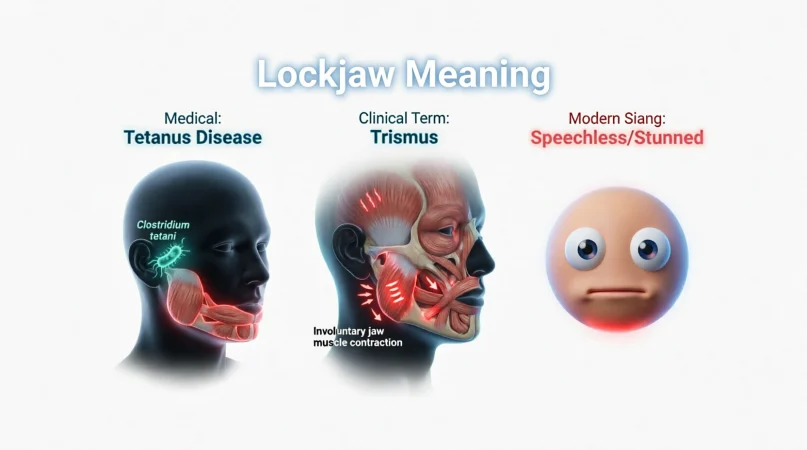
If you have seen the word “lockjaw” in a text, comment, meme, or social media post, you may have wondered what the person actually meant. Is it slang? Is it describing someone who is speechless? Or does it have something to do with a medical condition?
The answer depends heavily on context. In everyday English, lockjaw traditionally refers to a condition in which the jaw becomes stiff or difficult to open. It is also a common name for tetanus, a serious bacterial infection that can cause painful muscle stiffness and spasms.
Online, however, people may use the word more casually. Someone might say they were “hit with lockjaw” to describe being unable to speak, having a stiff jaw from laughing, or simply feeling as though they cannot get their words out. In some conversations, the intended meaning may be literal rather than slang. That is why understanding the surrounding sentence matters.
In this guide, we will look at the meaning of lockjaw in text messages, social media, casual conversation, and medical contexts. We will also cover examples, related expressions, common misunderstandings, and how to tell which meaning someone intends.
What Does “Lockjaw” Mean?
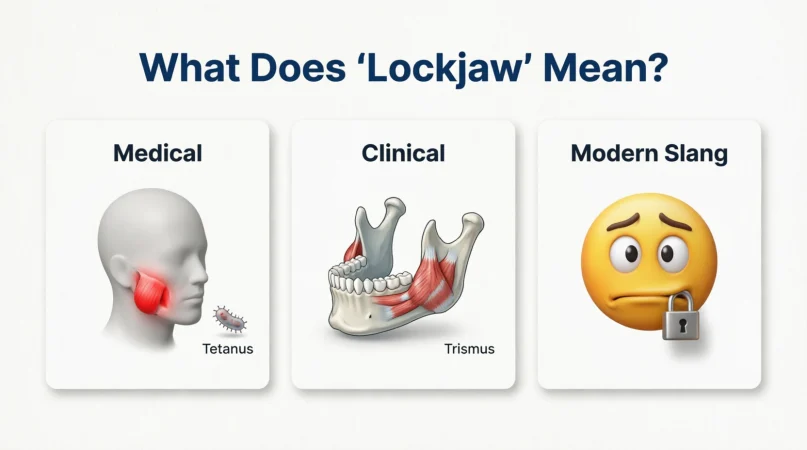
Lockjaw generally describes a condition or sensation in which the jaw feels stiff, tight, or difficult to open.
The word has two major uses:
- Medical meaning: Lockjaw is a traditional term associated with tetanus, an infection that can cause severe muscle stiffness and spasms.
- Everyday or informal meaning: Someone may use “lockjaw” to describe a jaw that feels stuck, tight, stiff, or unable to move normally.
The word itself is quite literal. “Lock” suggests something being stuck in place, while “jaw” refers to the lower or upper jaw.
So if someone writes:
“I woke up with lockjaw.”
They could simply mean that their jaw feels stiff or difficult to move.
But if someone posts:
“That joke gave me lockjaw 😂”
the meaning is likely playful. They may be saying that they laughed so hard that their jaw hurt or felt stiff.
This distinction is important because lockjaw is not primarily an internet slang term. Unlike expressions such as “LOL,” “FR,” or “IMO,” it has a well-established meaning outside social media.
Lockjaw Meaning in Text Messages
When you see lockjaw in a text, don’t automatically assume it has a special slang definition.
The surrounding words usually tell you what the sender means.
For example:
“My jaw is killing me. I think I have lockjaw.”
Here, the person is probably describing physical jaw stiffness.
Compare that with:
“Bro, I laughed so hard I got lockjaw.”
This is more likely an exaggerated or humorous expression.
Another example:
“She had lockjaw during the presentation.”
That could mean the person was physically unable to open her mouth properly, but it could also be an informal way of saying she froze and could not speak. You would need to consider the broader conversation.
In other words, there is no single secret texting definition that applies every time.
Is Lockjaw a Slang Word?
It can be used informally, but it is not inherently slang.
This is one of the biggest points to understand.
Words such as “lockjaw” can move between formal, medical, conversational, and humorous contexts without changing their basic meaning. Online users sometimes stretch a word’s meaning for dramatic effect, but that does not necessarily create a new slang definition.
If someone uses “lockjaw” jokingly, the meaning may come from the situation rather than from a dictionary-style slang definition.
For example:
“That food was so spicy I got lockjaw.”
The speaker probably does not literally have tetanus. They are exaggerating how intense the experience felt.
Lockjaw Meaning on Social Media
On social media, people often use ordinary words creatively.
That is especially true in memes, comments, captions, and short-form posts where exaggeration is common.
You might see phrases such as:
- “This had me in lockjaw.”
- “I got lockjaw from laughing.”
- “Bro had lockjaw.”
- “Why did I suddenly get lockjaw?”
- “That picture gave me lockjaw.”
The intended meaning can vary.
In a humorous post, it might suggest that someone laughed so hard their jaw hurt. In another post, it could mean that a person was stunned, speechless, or unable to respond.
Sometimes users simply mean “my jaw feels stuck” without intending any slang at all.
Why Context Matters Online
Internet language changes quickly, but context remains one of the best ways to interpret unfamiliar expressions.
Imagine someone comments:
“I saw that price and got lockjaw.”
They could be joking that they were so shocked they could not speak.
Now imagine:
“I can’t open my mouth properly. I’ve had lockjaw since yesterday.”
That sounds much more literal and potentially medical.
The same word appears in both examples, but the intended meaning is completely different.
When interpreting unfamiliar online language, look at:
- The words immediately before and after it
- Emojis
- Whether the conversation is serious or humorous
- Whether the person is discussing health
- Whether the phrase is being used as an exaggeration
- Whether the speaker is describing an actual physical sensation
This approach is more reliable than assuming every unusual word has a fixed slang meaning.
What Does Lockjaw Mean Medically?
The medical meaning deserves special attention because lockjaw is commonly associated with tetanus.
Tetanus is a serious infection caused by bacteria called Clostridium tetani. The bacteria can enter the body through a wound and produce a toxin that affects the nervous system.
One of the classic symptoms is jaw muscle stiffness, which is where the term “lockjaw” comes from.
A person with tetanus may have difficulty opening their mouth because the muscles controlling the jaw become rigid or go into spasms.
However, having a stiff jaw does not automatically mean someone has tetanus.
There are many possible reasons for jaw stiffness, including dental problems, muscle tension, temporomandibular joint issues, teeth grinding, injury, or other conditions.
If jaw stiffness is severe, persistent, worsening, or accompanied by other concerning symptoms, medical advice is appropriate.
Why Is Tetanus Called Lockjaw?
The nickname comes directly from one of the condition’s recognizable symptoms.
Tetanus can cause painful muscle contractions and stiffness. When the muscles around the jaw are affected, opening the mouth can become extremely difficult.
Historically, this symptom was so closely associated with tetanus that “lockjaw” became a common name for the disease.
So when someone says:
“Lockjaw is another name for tetanus.”
That is broadly understandable in everyday language.
However, it is more precise to say that lockjaw is a traditional term associated with tetanus, especially because of the jaw stiffness it can cause.
This distinction matters because not every case of a stiff or “locked” jaw is caused by tetanus.
Lockjaw vs. Being Speechless
One confusing use of the word occurs when people use physical language to describe an emotional reaction.
Suppose somebody says:
“When he asked me that question, I had lockjaw.”
They may not be talking about their jaw muscles at all.
They could mean:
“I was so nervous or surprised that I couldn’t say anything.”
English has many expressions like this. We often describe strong emotions through physical sensations.
For example:
- “I was tongue-tied.”
- “I couldn’t get a word out.”
- “I froze.”
- “My mouth went dry.”
- “I was speechless.”
“Lockjaw” can sometimes be used in a similar playful way, although “tongue-tied” and “speechless” are much more standard expressions for being unable to speak.
That means you should not assume “lockjaw” always means “speechless.” It depends on how the speaker is using it.
Lockjaw Examples in Texting
Here are some realistic examples showing how the word can work in different situations.
Example 1: Physical stiffness
Person A: Why aren’t you talking?
Person B: My jaw is really stiff today. I think I’ve got lockjaw.
Here, the word is being used literally.
Example 2: Humor
“That video had me laughing so hard I got lockjaw 😂”
This is probably an exaggeration about laughing.
Example 3: Shock
“I saw the final bill and got lockjaw.”
This likely means the person was so shocked that they were momentarily speechless.
Example 4: Medical discussion
“The doctor asked whether I had difficulty opening my mouth because lockjaw can be a symptom of tetanus.”
Here, the word clearly has a medical meaning.
Example 5: Nervousness
“Every time I try to talk to my crush, I get lockjaw.”
This could be humorous shorthand for becoming nervous and struggling to speak.
Example 6: Meme language
“Bro saw the exam questions and immediately developed lockjaw 💀.”
This is almost certainly figurative. The person is joking that the exam left someone speechless.
Notice how little the word itself changes. The context creates the meaning.
Does Lockjaw Mean “Can’t Talk”?
Not necessarily.
Some people may use it that way, especially in jokes or casual online conversation, but “lockjaw” does not universally mean “can’t talk.”
Its literal sense involves stiffness or difficulty moving the jaw.
If you want to say that someone cannot speak, clearer expressions include:
- Speechless
- Tongue-tied
- Lost for words
- Unable to speak
- Couldn’t get a word out
- Froze up
If a friend uses “lockjaw” to mean they suddenly could not speak, you can usually understand it from context. But you should not assume that this is the standard dictionary meaning.
Lockjaw and “Tongue-Tied”: What’s the Difference?
These two expressions can overlap in casual conversation, but they describe different ideas.
Lockjaw focuses on the jaw being stiff, stuck, or difficult to move.
Tongue-tied usually means having difficulty speaking clearly, often because of nervousness, embarrassment, confusion, or excitement.
For example:
“I couldn’t open my mouth because my jaw was stiff.”
That fits the literal idea of lockjaw.
Meanwhile:
“I knew what I wanted to say, but I got tongue-tied.”
That describes difficulty finding or expressing words.
Someone might jokingly use lockjaw for the second situation, but “tongue-tied” is the more established expression.
Is “Lockjaw” Offensive?
Generally, no.
The word itself is not normally considered offensive, vulgar, or insulting.
However, the way it is used can affect how it sounds.
If you use “lockjaw” to joke about someone’s medical condition, the person might find that insensitive. Likewise, using someone’s health problem as the punchline of a joke can be inappropriate even if the word itself is harmless.
In ordinary conversation, saying:
“My jaw feels locked.”
is straightforward.
Saying:
“That meme gave me lockjaw 😂”
is clearly more playful.
As with many words, tone and situation matter.
Is Lockjaw Still Common?
The word is recognizable, but it is not necessarily one of the most common terms in everyday conversation.
Many people are more likely to say:
- “My jaw is stiff.”
- “My jaw is locked.”
- “I can’t open my mouth.”
- “My jaw hurts.”
- “I think I have a TMJ problem.”
The word is particularly familiar because of its connection with tetanus.
You may therefore encounter “lockjaw” more often in health discussions, older writing, educational material, or explanations of tetanus than in ordinary texting.
Online, its use may be more creative and humorous.
Common Misunderstandings About Lockjaw
Because the word can be used in several ways, it is easy to misunderstand.
Misunderstanding 1: Every use refers to tetanus
Not true.
Someone saying “I have lockjaw” casually may simply be describing jaw stiffness or using the term humorously.
Misunderstanding 2: Lockjaw always means being speechless
Also not true.
That can be an informal interpretation, but the traditional meaning concerns jaw stiffness and difficulty opening the mouth.
Misunderstanding 3: Lockjaw is purely internet slang
No.
The term existed long before social media and has an established medical meaning.
Misunderstanding 4: A stiff jaw automatically means tetanus
No.
There are numerous possible causes of jaw stiffness. Tetanus is one important possibility in the right circumstances, but the word itself is not a diagnosis.
Misunderstanding 5: The online meaning is fixed
Internet language is flexible.
One community may use a term differently from another, and an individual may invent a humorous use based on a particular situation.
How to Figure Out What Someone Means by Lockjaw
If you encounter the word in a message and aren’t sure what it means, use the surrounding context.
Ask yourself:
Is the person talking about their body?
If they mention pain, stiffness, injury, chewing, opening their mouth, or a doctor, the literal meaning is likely.
Are they laughing or using emojis?
If the sentence includes “LOL,” laughing emojis, or exaggerated language, the word may be humorous.
Are they describing an awkward social situation?
It could be a playful way of saying they froze or did not know what to say.
Are they discussing tetanus?
Then the medical meaning is almost certainly intended.
Does the phrase sound exaggerated?
Online users frequently use physical terms dramatically. A statement such as “that exam gave me lockjaw” is probably not a literal medical claim.
Context is often more useful than trying to memorize a single slang definition.
Lockjaw in Memes and Comments
Memes have a way of turning ordinary words into exaggerated reactions.
People regularly describe laughter, shock, embarrassment, fear, and disbelief through physical imagery.
For example:
“My jaw is locked after seeing that.”
or:
“This comment section gave me lockjaw.”
The speaker may be joking about being shocked or unable to think of a response.
This style of language is common because it makes a reaction sound more dramatic.
The important thing is not to interpret every humorous use literally.
If someone says:
“That performance gave me lockjaw.”
they probably aren’t claiming to have developed a serious medical condition. They may simply mean that the performance left them stunned.
Can Lockjaw Be Used as a Verb?
In informal speech, people may creatively turn the noun into a verb.
For example:
“That joke lockjawed me.”
This is not standard formal English and sounds deliberately playful.
More natural expressions would be:
“That joke gave me lockjaw.”
or:
“That joke left me speechless.”
Online communities often experiment with grammar, especially in memes and jokes. That does not mean every improvised form is a recognized dictionary expression.
If you are writing something formal, it is better to use conventional wording.
Lockjaw Meaning in Different Situations
A quick comparison can make the different uses easier to understand.
| Context | Likely meaning |
|---|---|
| Medical discussion | Jaw stiffness associated with a condition such as tetanus |
| Talking about pain | A stiff, tight, or difficult-to-open jaw |
| Joke about laughing | Exaggeration about jaw pain or stiffness |
| Meme about shock | Being stunned or speechless |
| Nervous conversation | Playful way of saying someone froze or struggled to speak |
| Casual description | Jaw that feels stuck or restricted |
This is why a simple dictionary definition may not be enough when interpreting a social media post.
What Should You Reply If Someone Says “I Have Lockjaw”?
Your response depends on the context.
If they are joking, you can respond naturally:
“😂 What happened?”
If they are describing actual jaw stiffness, you could ask:
“Is it painful, and can you open your mouth normally?”
If they mention a possible injury or serious symptoms, it is better not to treat the statement as a joke.
And if someone is concerned about tetanus or has symptoms that could indicate a serious infection, they should seek appropriate medical care rather than relying on an internet interpretation of the word.
The key point is that the slang-style use of lockjaw should not distract from a genuine health concern.
What Is the Opposite of Lockjaw?
There isn’t one perfect opposite because the word can be used both literally and figuratively.
If you mean the physical sense, an opposite might be:
- A relaxed jaw
- Normal jaw movement
- An open, unrestricted mouth
If you mean the figurative sense of being unable to speak, possible opposites include:
- Speaking freely
- Finding your words
- Being talkative
- Expressing yourself clearly
Again, the intended meaning determines which answer makes sense.
Is Lockjaw the Same as a Locked Jaw?
Not always.
The phrases sound almost identical, but “locked jaw” can be used more generally to describe a jaw that feels stuck or cannot move normally.
“Lockjaw” is a specific word with a historical medical association with tetanus, while “locked jaw” can simply describe a symptom or physical sensation.
For example:
“My jaw feels locked after chewing gum all afternoon.”
This doesn’t necessarily imply tetanus.
Similarly:
“The dentist said my jaw was stiff.”
is simply a description of a symptom.
This is another reason context matters when interpreting the word.
How to Use “Lockjaw” Correctly
If you are using the term yourself, consider your audience.
In casual conversation, you might say:
“My jaw is so stiff today. It feels like lockjaw.”
In a joke:
“That meme gave me lockjaw 😂.”
In a medical conversation, be more precise:
“I am having difficulty opening my mouth.”
This makes it easier for the other person to understand exactly what you mean.
If you are writing for work, school, or a professional audience, avoid using “lockjaw” as vague slang unless the context is obvious.
Clear language is especially important when discussing symptoms.
Why Internet Slang Can Be Confusing
One reason people search for meanings of words like “lockjaw” is that online language does not always follow traditional definitions.
A person can take an ordinary word and give it a humorous meaning based on a particular meme, community, or conversation.
The meaning may also shift depending on tone.
For example, “dead” can mean physically dead, extremely tired, or laughing intensely in online slang. “Sick” can describe illness or something impressive. “Crazy” can describe something unusual without literally referring to mental illness.
Lockjaw can work in a similar way: its literal meaning remains intact, but people may use it figuratively.
This is why good interpretation requires more than searching for a one-line definition.
Frequently Asked Questions
What is the simple meaning of lockjaw?
In simple terms, lockjaw means stiffness or difficulty opening the jaw. It is also a traditional name associated with tetanus.
What does lockjaw mean in texting?
In texting, it usually depends on context. It may describe actual jaw stiffness, or it may be used jokingly to suggest that someone is stunned, laughing hard, or unable to speak.
Is lockjaw internet slang?
Not originally. The term has a long-established meaning in everyday and medical English. Social media users can use it informally or humorously, but that does not make the word exclusively internet slang.
Does lockjaw mean speechless?
Sometimes people use it that way figuratively, but that is not the primary meaning of the word. “Speechless,” “tongue-tied,” or “lost for words” are clearer expressions.
Does lockjaw mean tetanus?
Lockjaw is a traditional term associated with tetanus because tetanus can cause severe jaw stiffness. However, not every stiff or locked jaw is caused by tetanus.
Why do people say “I got lockjaw”?
The meaning depends on the situation. They could be talking about physical stiffness, or they could be joking that they became unable to speak or were overwhelmed by laughter, surprise, or nervousness.
Is lockjaw a bad word?
No. “Lockjaw” is not normally considered a swear word or offensive term. Its appropriateness depends on how and why it is being used.
Can I use lockjaw in formal writing?
You can use it when it is accurate and relevant, particularly when discussing its medical or historical meaning. For casual figurative uses, clearer wording is usually preferable in formal writing.
Final Takeaway
So, what does lockjaw mean in text? The safest answer is: it depends on context. At its core, lockjaw describes a jaw that is stiff, tight, or difficult to open. The term is also strongly associated with tetanus because jaw stiffness is a classic symptom of that infection.
On social media and in text messages, however, people may use the word more loosely. It can jokingly suggest that someone was stunned, speechless, extremely amused, nervous, or physically affected by laughing.
The important thing is not to treat every online use as a fixed slang definition. If the conversation is about health, take the word literally and look at the symptoms being described. If it appears in a meme or joke, the speaker may be using it figuratively. And if you are unsure, the surrounding sentence will usually provide the clue.
In short, “lockjaw” is an ordinary English word with a medical history that can also be used creatively online. Understanding the context is the best way to understand what the person actually means.
Discover more post
211 Meaning What It Really Means in Text 2026
Paladin Meaning Definition 2026
What Does puffery meaning in Text? 2026

Mia is a passionate humor writer and wordplay specialist at MeanlyGuru. She creates clean, clever, and shareable puns, jokes, and light-hearted content designed for global readers. Her writing style is simple, smart, and highly engaging—perfect for social media, daily laughs, and modern digital audiences.