
Have you ever been chatting with someone, sharing a funny story, or talking about your day when they suddenly reply, “TMI!”? If you are unsure what they mean, you are not alone. Internet slang can be confusing, especially when a short abbreviation has a specific meaning in everyday conversations.
So, what does TMI mean in a text? TMI stands for “Too Much Information.” People use it when someone shares more personal, private, embarrassing, or unnecessary details than the listener wants to know.
For example, imagine telling your friend every detail about an awkward doctor’s appointment. Your friend might respond, “Okay, TMI 😂.” They are probably saying that you have shared more information than they needed, often in a playful way.
However, TMI is not always a joke. Depending on the conversation, it can express embarrassment, discomfort, surprise, or a polite request to stop sharing certain details.
In this guide, you will learn what TMI means in texting, how people use it on social media, what different responses communicate, and how to tell whether someone is joking or genuinely uncomfortable. You will also discover real-life examples, similar slang terms, and simple ways to respond when someone sends you this abbreviation.
What Does TMI Mean in a Text?
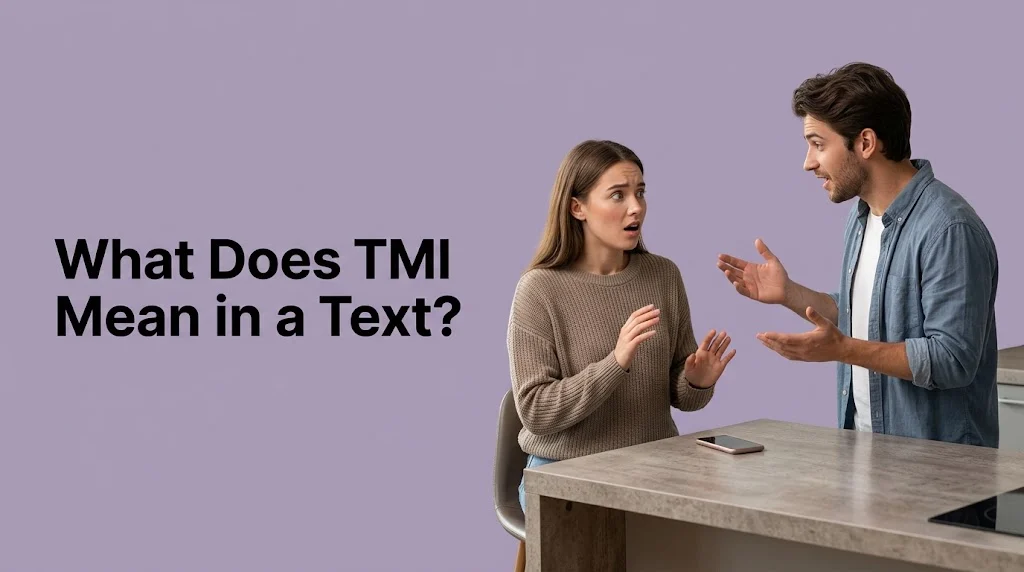
TMI means “Too Much Information.” It is a common internet abbreviation used in text messages, online chats, social media comments, and everyday conversations.
People usually say it when a person shares details that feel too personal, graphic, embarrassing, or simply unnecessary for the situation.
For example:
Person A: “I had the worst stomach problems this morning. Let me explain exactly what happened…”
Person B: “TMI! 😭”
In this conversation, Person B is telling their friend that the story includes more details than they wanted to hear.
The expression does not necessarily mean that the information is false or inappropriate. It simply means that the listener thinks the conversation has gone further than they are comfortable with.
TMI can be used between close friends, family members, romantic partners, coworkers, and strangers online. The meaning stays the same, but the tone can change depending on the relationship.
With friends, it often sounds funny and casual. In a serious conversation, it may communicate a genuine boundary.
What Does TMI Stand For?
TMI stands for:
- T: Too
- M: Much
- I: Information
The phrase existed before texting became popular. People used it in spoken conversations, television, magazines, and casual discussions long before abbreviations became common on the internet.
As texting and social media grew, TMI became an easy way to express the same idea using just three letters.
Instead of writing, “You are sharing more personal details than I need to know,” someone can simply type “TMI.”
That is one reason the abbreviation remains useful in everyday digital communication.
Is TMI Positive or Negative?
TMI is usually neutral to mildly negative, but it can be playful depending on the context.
For example, if a friend shares an embarrassing story and you respond with “TMI 😂,” you may be laughing with them rather than criticizing them.
However, if someone describes an uncomfortable personal experience and another person replies “TMI,” the response may sound dismissive or insensitive.
The key is to consider what was said before the abbreviation appeared, how the person normally communicates, and whether they added emojis or other words.
TMI does not automatically mean that someone is angry. It often means that the conversation has become more detailed than they expected.
How Is TMI Used in Text Messages?
People use TMI in several everyday situations. Although the basic meaning stays the same, the intention behind it can vary.
Here are some common ways you might see it in a text conversation.
1. When Someone Shares Too Many Personal Details
This is one of the most common uses of TMI.
A person may describe a private health issue, a bathroom experience, a personal hygiene routine, or another subject that others would rather not discuss in detail.
Example:
Friend: “I spent twenty minutes explaining every symptom I had yesterday.”
You: “Okay, TMI 😂”
Your reply suggests that the explanation has become more detailed than necessary.
2. When a Story Becomes Embarrassing
Sometimes people use TMI when a story includes awkward or embarrassing information.
Example:
Alex: “I waved at someone who wasn’t waving at me, then I tripped while trying to walk away.”
Sam: “That’s embarrassing 😭 TMI about my secondhand embarrassment!”
Here, the expression is used humorously. The person may be reacting to the uncomfortable nature of the story rather than asking the speaker to stop.
3. When Someone Discusses Private Relationship Details
TMI can also appear in conversations about dating, romantic relationships, or personal experiences.
For example:
Person A: “My boyfriend and I had a really awkward argument last night. Here’s every detail.”
Person B: “You can skip the private details, TMI.”
In this situation, the person is expressing a preference not to hear the entire story.
4. When Someone Overshares on Social Media
People sometimes post highly personal information on public platforms. Other users may respond with TMI when they believe the post reveals more than most people need to know.
For example, someone might publish a long post describing every detail of a private medical appointment. A commenter could write, “TMI, but I hope you’re feeling better.”
That response combines two ideas: the commenter thinks some details were unnecessary, but they still wish the person well.
Of course, not everyone who shares personal information is oversharing. Some people use social media to discuss health, relationships, and difficult experiences to help others feel less alone. Whether TMI is appropriate depends on the subject, the audience, and the way the information is presented.
5. When Someone Wants to Set a Boundary
TMI can be a short way to communicate discomfort.
Example:
Coworker: “Let me tell you everything about my personal medical situation.”
You: “I hope you’re doing okay, but that’s a little TMI for work.”
This response makes the boundary clearer while remaining respectful.
If the subject is sensitive, a gentle explanation may work better than simply saying “TMI,” which could sound rude.
Real Text Message Examples of TMI
The easiest way to understand internet slang is to see how people actually use it in conversations.
Here are several realistic examples showing different meanings and tones.
Example 1: Talking About a Stomach Problem
Mia: “I ate too much yesterday, and my stomach has been making the weirdest noises.”
Emma: “LOL, TMI 🤢”
Meaning: Emma thinks Mia is sharing more information than she wants to hear. The laughing and disgust emojis make the response sound playful.
Example 2: Sharing an Awkward Date Story
Noah: “She spent the entire date talking about her ex and showing me all their old messages.”
Liam: “Bro, TMI 😂”
Meaning: Liam thinks the details are excessive or uncomfortable. Depending on their friendship, he may be joking about how awkward the date sounds.
Example 3: Talking About a Medical Appointment
Sarah: “My doctor explained every detail of the procedure, and now I can’t stop thinking about it.”
Jess: “Oh no, that sounds stressful. You can leave out the graphic details, though. TMI for me.”
Meaning: Jess wants to support Sarah but prefers not to hear potentially upsetting descriptions.
Example 4: Sharing a Romantic Story
Alex: “Want to hear every detail of my anniversary night?”
Jamie: “Maybe the short version 😂 TMI might be a little too much.”
Meaning: Jamie is comfortable hearing about the anniversary but does not want an overly detailed account.
Example 5: A Family Group Chat
Brother: “Dad just told me the whole story about his last doctor’s visit.”
Sister: “WHY DOES HE ALWAYS DO THIS 😭 TMI!”
Meaning: The sister finds the amount of information excessive and is reacting humorously.
Example 6: A Social Media Comment
User: “I posted a 20-minute video explaining my entire morning routine, including all my bathroom problems.”
Commenter: “TMI, but you do you 😂”
Meaning: The commenter thinks the post contains unnecessary personal details but expresses that opinion casually.
Example 7: A Serious Conversation
Person A: “I don’t feel comfortable discussing my private life in this much detail.”
Person B: “Sorry, I didn’t realize it was TMI. We can talk about something else.”
Meaning: The second person recognizes the boundary and agrees to change the subject.
These examples show that TMI can be funny, awkward, mildly critical, or serious. The surrounding conversation helps you understand which meaning applies.
What Does TMI Mean on Social Media?
On social media, TMI has the same basic meaning as in text messages: “Too Much Information.”
However, the way people use it can vary between platforms and communities.
TMI on TikTok
On TikTok, TMI may appear in video comments, captions, storytimes, and reactions to personal disclosures.
For example, a creator might share a detailed story about an embarrassing experience. Someone in the comments may write, “Girl, TMI 😭.”
This could be friendly teasing, especially if the creator is known for sharing funny personal stories.
In other situations, viewers might use TMI to criticize content they consider too graphic or private.
The meaning depends on the creator’s style, the subject, and the commenter’s tone.
TMI on Instagram
On Instagram, people may use TMI in comments, direct messages, Stories, or private group chats.
For example:
“Your story about the date was hilarious, but the last part was TMI 😂.”
Here, the person enjoyed the story overall but thought one section included unnecessary details.
Friends may also use TMI when replying to a long voice message or a personal update.
TMI on Snapchat
Snapchat conversations are often casual and informal, making TMI a natural fit.
For example:
Friend: “I’m about to send you a voice note explaining everything that happened this morning.”
You: “Keep it short pls, no TMI 😭”
In this context, the sender is asking for a shorter explanation without unnecessary personal details.
TMI on Facebook
On Facebook, TMI can appear in comments, posts, and private group discussions.
Someone might use it when a person shares highly personal information in a public setting.
However, what counts as too much information is subjective. A post that one person considers excessive may help another person understand an important issue.
It is helpful to distinguish between personal preference and genuine harm when responding to sensitive posts.
TMI on X and Other Discussion Platforms
On discussion-focused platforms, TMI may be used as a short reaction to an unusually detailed post.
For example:
“Interesting story, but the bathroom details were TMI.”
This response makes the speaker’s preference clear without requiring a long explanation.
Across platforms, the abbreviation remains recognizable because it expresses a simple idea: the amount or type of information is more than the listener wants.
What Does TMI Mean From a Girl or a Guy?
Sometimes people search for the meaning of TMI specifically when it comes from a girl, a guy, or someone they like.
The important thing to understand is that TMI does not have a different definition based on who sends it. It still means “Too Much Information.”
What may change is the intention behind the message.
When a Girl Texts TMI
If a girl replies “TMI 😂” to your message, she may be joking about an embarrassing story, reacting to a personal detail, or letting you know that you have shared more than she wanted to hear.
For example:
You: “I accidentally sent a voice message while I was talking to myself.”
Her: “LMAO TMI 😭”
She is probably reacting playfully to the awkward situation.
However, if she responds with “TMI. I don’t want to hear about that,” take her words seriously. She may be setting a clear boundary.
When a Guy Texts TMI
If a guy texts “TMI,” he may be joking with you, reacting to a graphic story, or asking you to avoid unnecessary details.
For example:
You: “Let me explain everything that happened at the doctor’s office.”
Him: “TMI bro 😂”
He may simply prefer a shorter explanation.
There is no universal rule that guys use TMI differently from girls. Personality, friendship, humor, and context matter much more than gender.
What If Your Crush Says TMI?
If your crush responds with “TMI,” it is natural to wonder whether they are embarrassed, uncomfortable, or teasing you.
The abbreviation alone cannot tell you whether someone is romantically interested in you.
Look at the rest of the conversation instead. Are they laughing and continuing to chat? Are they asking questions? Or are they clearly trying to end the subject?
If the tone seems playful, you can respond with humor. If they appear uncomfortable, respect that and change the topic.
Avoid treating one short text as proof of someone’s feelings.
Does TMI Mean Someone Is Being Rude?
Not necessarily.
TMI can be friendly teasing between people who know each other well. It can also be a reasonable way to communicate a preference about personal topics.
However, the expression can sound rude when it dismisses someone who is sharing something important or vulnerable.
Consider these two examples.
Playful use:
“Okay, TMI 😂 I did not need to know what happened after the spicy noodles.”
Potentially insensitive use:
“I was trying to explain a frightening medical experience, and you just said TMI.”
The first example sounds like casual humor. The second shows how the expression can feel dismissive when someone needs support.
If a person is discussing trauma, illness, grief, or another serious subject, a more thoughtful response may be appropriate.
For instance, instead of saying “TMI,” you could say:
“I’m sorry you’re dealing with that. I want to support you, but I might not be comfortable discussing all the details.”
This communicates your limits without suggesting that the other person should feel ashamed.
Likewise, if someone tells you that your message was TMI, you do not have to take it as a personal attack. They may simply have different boundaries.
How to Respond When Someone Texts TMI
If someone sends you TMI, you do not need to overthink your reply. The best response depends on whether the person seems to be joking or genuinely asking you to stop.
Here are some natural responses for different situations.
1. Respond With Humor
If you are chatting with a close friend and the conversation is playful, you can joke back.
Examples:
- “Oops, my bad 😂”
- “You asked for the story!”
- “LOL, I’ll spare you the rest.”
- “Too late, you’ve already heard it 😭”
- “Okay, okay, I’ll stop.”
These responses keep the mood light without making the conversation awkward.
2. Apologize Briefly
If you realize that you shared more than the other person wanted to hear, a simple apology is enough.
Examples:
- “Sorry, I got carried away.”
- “My bad, I didn’t mean to overshare.”
- “Sorry about that. Let’s talk about something else.”
- “Got it. I’ll keep the details shorter next time.”
You do not need to give a long explanation. Acknowledging their preference is usually sufficient.
3. Change the Subject
Sometimes the easiest response is to move on.
For example:
Friend: “TMI 😭”
You: “Fair enough 😂 Anyway, how was your weekend?”
This acknowledges their reaction and smoothly redirects the conversation.
4. Clarify What They Mean
If you cannot tell whether the person is joking, you can ask a simple question.
For example:
“Wait, do you mean TMI as a joke, or should I stop talking about it?”
This can be useful when discussing a sensitive subject or when you are unfamiliar with the person’s communication style.
5. Set Your Own Boundary
TMI can also come up when someone asks you to share information you would rather keep private.
You can say:
- “I’d rather not get into the details.”
- “That’s a little too personal for me to discuss.”
- “I’m happy to give you the short version.”
- “I’d prefer to keep that private.”
You are not required to disclose personal information simply because someone asks.
What Is the Difference Between TMI, Oversharing, and Being Personal?
These expressions are related, but they do not mean exactly the same thing.
TMI is a reaction to information that someone considers excessive or unwanted.
Oversharing describes the act of revealing more personal information than may be appropriate for the situation.
Being personal simply means discussing something related to your own experiences, emotions, relationships, or private life.
For example, telling a friend that you had a difficult day is personal, but it is not necessarily oversharing.
Explaining every private detail of an argument in a public group chat might be considered oversharing by some people.
If another person responds with “TMI,” they are expressing their view that the information is too much for them.
These judgments depend on the audience and setting. Sharing personal experiences can also be valuable, especially when it helps people feel understood or provides useful information.
The goal is not to avoid personal conversations entirely. It is to recognize that different people have different comfort levels.
TMI vs. Similar Texting Abbreviations
If you are learning internet slang, it helps to understand how TMI compares with other common abbreviations.
| Slang | Full Meaning | Typical Use |
|---|---|---|
| TMI | Too Much Information | Reacting to excessive or personal details |
| LOL | Laughing Out Loud | Showing amusement |
| TBH | To Be Honest | Introducing an honest opinion |
| FYI | For Your Information | Sharing useful or relevant information |
| IMO | In My Opinion | Expressing a personal view |
| IDK | I Don’t Know | Showing uncertainty |
| BTW | By The Way | Introducing an additional point |
| NGL | Not Gonna Lie | Introducing a candid statement |
| SMH | Shaking My Head | Expressing disappointment or disbelief |
| NSFW | Not Safe For Work | Warning about potentially inappropriate content |
Although these abbreviations can appear in the same conversation, they serve different purposes.
For example:
Friend: “NGL, I told my date every embarrassing thing about myself in the first ten minutes.”
You: “LOL, TMI 😂”
Here, NGL introduces an honest statement, LOL expresses amusement, and TMI reacts to the personal details.
Learning these differences makes online conversations easier to understand.
Can TMI Be Used as a Joke?
Yes. TMI is frequently used humorously, particularly among friends who are comfortable teasing one another.
Sometimes the information is not particularly private or inappropriate. The joke is simply that someone has given an unnecessarily detailed explanation.
For example:
Person A: “I woke up, brushed my teeth, washed my face, and then spent four minutes deciding which socks to wear.”
Person B: “TMI about the socks 😂”
The second person is joking about the unnecessary level of detail.
People may also use TMI ironically when they deliberately provide a long explanation of something ordinary.
For example, a person might describe their entire breakfast in a group chat and finish with, “Anyway, TMI about my toast.”
In this case, the speaker knows the details are not important and is making fun of their own tendency to overshare.
Emojis such as 😂, 😭, 🤣, and 🙈 can make a message sound playful, although emojis alone do not guarantee that the person is joking.
Can TMI Be Used in Professional Conversations?
TMI is informal slang, so it is generally better suited to casual communication than formal business writing.
You might use it with a coworker you know well, especially in a relaxed workplace chat. However, it may not be the best choice in an email to a manager, a client conversation, or a formal meeting.
For example, instead of writing:
“That’s TMI for this meeting.”
You could say:
“Let’s focus on the details that are relevant to the project.”
Or, if someone is sharing personal information:
“Thank you for explaining. We may not need to discuss all the personal details here.”
These alternatives communicate the same general idea without sounding dismissive.
Professional communication often benefits from clear, respectful language rather than slang that could be misunderstood.
What Does TMI Mean in Different Situations?
Although the definition stays the same, the intended message can change according to the situation.
Here is a quick guide.
| Situation | What TMI Usually Communicates |
|---|---|
| A funny story | “That was more detail than I needed, haha.” |
| A graphic description | “I don’t want to hear those details.” |
| A romantic conversation | “That information feels too personal for me.” |
| A group chat | “This might be more detail than everyone needs.” |
| A social media post | “This feels overly personal or unnecessary to share publicly.” |
| A serious discussion | “I’m uncomfortable with this level of detail.” |
| A conversation with a close friend | “I’m teasing you about oversharing.” |
If you are uncertain about the meaning, consider the topic, the relationship, and what happened immediately before the message.
For example, “TMI 😂” after a silly story is likely different from “That’s TMI. Please stop” during an uncomfortable discussion.
The words around the abbreviation often provide the clearest clue.
Is TMI Still Used in 2026?
Yes. TMI remains an understandable abbreviation in online and everyday communication.
Although internet slang changes constantly, some expressions continue to be useful because they communicate familiar ideas quickly.
TMI is short, easy to type, and widely understandable to people who are familiar with English-language texting culture.
You may encounter it in private messages, group chats, comment sections, memes, video reactions, and casual spoken conversations.
It is also useful outside the internet. People sometimes say “That’s TMI” aloud when a conversation includes unnecessary personal details.
However, not everyone uses slang in the same way. Some people prefer full sentences, while others communicate through short abbreviations and emojis.
If you encounter TMI in a message, you can usually understand it from the context without needing to know every other internet slang term.
Common Misunderstandings About TMI
Because TMI is such a short expression, it is easy to misunderstand what someone intends to communicate.
Here are a few common mistakes to avoid.
Misunderstanding 1: Thinking TMI Always Means Someone Is Angry
TMI does not automatically indicate anger.
A friend might use it as a joke, a playful reaction, or a lighthearted way of saying that your story has become too detailed.
Look at the rest of the conversation before assuming that the person is upset.
Misunderstanding 2: Assuming TMI Is Always an Insult
Although it can sound critical, TMI is not necessarily an insult.
Someone may simply prefer not to discuss certain topics or hear graphic descriptions.
If the person communicates their preference respectfully, you can acknowledge it without treating the exchange as an argument.
Misunderstanding 3: Thinking Personal Information Is Always TMI
Not every personal detail is inappropriate.
People share experiences to connect with others, ask for help, discuss health concerns, and build relationships.
Whether something feels like too much depends on the audience, the situation, and the amount of detail shared.
Misunderstanding 4: Assuming TMI Reveals Romantic Interest
If your crush texts TMI, it does not automatically mean they like you or dislike you.
They may be joking, feeling embarrassed, or simply asking you to skip certain details.
One abbreviation is not enough to determine someone’s romantic feelings.
Misunderstanding 5: Believing TMI Is Only Used Online
TMI is common in texting and social media, but people also use it in spoken conversations.
You might hear someone say, “That’s TMI!” during a casual conversation with friends or family.
The expression is not limited to digital communication.
Frequently Asked Questions About TMI
1. What does TMI mean in a text from a friend?
When a friend texts TMI, they usually mean “Too Much Information.” They may be joking about an embarrassing story, reacting to personal details, or telling you that they do not want to hear more.
The tone depends on your friendship and the conversation.
2. What does TMI mean from a girl?
TMI means “Too Much Information” regardless of who sends it. A girl may use it playfully, express embarrassment, or communicate that a particular subject is too personal.
Consider the surrounding messages rather than assuming a specific intention based on gender.
3. What does TMI mean from a guy?
When a guy sends TMI, he is generally reacting to details he considers excessive, personal, or uncomfortable.
He may be joking with you or asking you to avoid sharing more information. The exact meaning depends on context.
4. What does TMI mean on Snapchat?
On Snapchat, TMI means “Too Much Information.” People use it in chats, snaps, and replies when someone shares more details than they want to hear.
For example, “TMI bro 😂” may be a playful reaction to an embarrassing story.
5. What does TMI mean on TikTok?
On TikTok, TMI often appears in comments about personal stories, embarrassing experiences, or detailed videos.
A comment such as “TMI 😭” may mean that the viewer finds the information excessive, awkward, or funny.
6. Is TMI rude to say?
Not always. Among friends, it can be playful. However, it may sound rude if used to dismiss someone who is sharing a serious problem.
If you want to communicate discomfort politely, explain that you would prefer not to discuss the details.
7. What is the difference between TMI and oversharing?
TMI is a reaction meaning “Too Much Information.” Oversharing is the act of revealing more personal information than the situation or audience may call for.
Someone might overshare, and another person might respond by saying TMI.
8. How should I reply to TMI?
You can reply with “Oops, my bad 😂,” “Sorry, I got carried away,” or “Fair enough, let’s change the subject.”
If the person seems uncomfortable, a brief apology and a change of topic are usually appropriate.
9. Does TMI have any other meanings?
In everyday texting and social media, TMI most commonly stands for “Too Much Information.” The abbreviation can have specialized meanings in particular professional or technical contexts, but the texting meaning is generally the relevant one in casual conversation.
10. Is TMI the same as NSFW?
No. TMI means “Too Much Information,” while NSFW means “Not Safe For Work.”
TMI is a reaction to excessive or unwanted details. NSFW is a warning that content may be inappropriate to view in a workplace or other public setting.
11. Can I use TMI in a professional email?
It is generally better to avoid informal slang in formal emails. Instead, say that certain details are unnecessary for the discussion or that you would prefer to keep the conversation focused on the relevant information.
12. Does TMI always refer to private or embarrassing information?
No. TMI can also refer to ordinary information that is unnecessarily detailed.
For example, a friend who describes every step of making a sandwich might receive a joking “TMI” even though nothing private or embarrassing was shared.
Final Thoughts: Understanding TMI in Everyday Texting
So, what does TMI mean in a text? It stands for “Too Much Information,” and people use it when a conversation includes more details than they want or need. You may see it in text messages, Snapchat chats, TikTok comments, Instagram conversations, and other forms of casual communication. It can express humor, embarrassment, discomfort, or a preference to keep certain details private.
The most important thing to remember is that TMI does not always mean someone is being rude or trying to end a conversation. Sometimes it is just friendly teasing. In other situations, it is a genuine request to change the subject. If someone sends you TMI, pay attention to the context. Respond with humor if the conversation is playful, apologize if you have made them uncomfortable, and respect their boundaries when the subject is sensitive.
Once you understand the meaning and tone, recognizing TMI becomes easy. It is a simple abbreviation that helps people communicate a common feeling: sometimes, a little less information is all they need.
Discover more post
What Does SMU in a Text Mean?2026
What Does RCS Mean in Google Text Mean 2026
What Does Brbr Mean in Text? 2026

Ari is a passionate digital content creator, humor writer, and online storytelling expert behind MeanlyGuru.com. With years of experience in SEO writing, content strategy, and lifestyle blogging, Ari delivers relatable, engaging, and highly shareable content that resonates with readers worldwide.