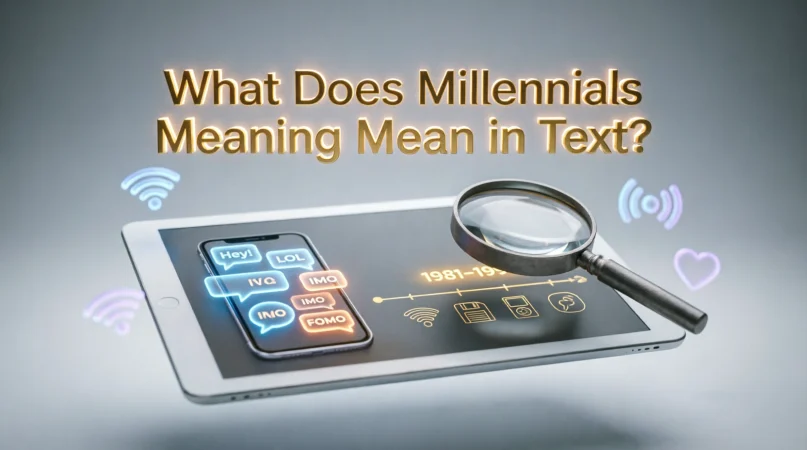
If you have seen the word “millennials” in a text, social media post, news article, or online conversation, you may have wondered what it actually means. The short answer is simple: millennials are people generally born between the early 1980s and the mid-1990s. They are also known as Generation Y, the generation that came after Generation X and before Generation Z.
But there is a little more to the word than a birth-year range. The term often comes up when people talk about technology, work, money, relationships, entertainment, social media, parenting, and changes in society. On the internet, someone might say, “That is such a millennial thing,” or “Millennials will remember this.” In these situations, the speaker is usually referring to experiences, habits, or cultural trends associated with people who grew up around the transition from an offline world to a digital one.
So, what exactly does millennials mean in text? Is it an insult? Is everyone born in a certain year automatically a millennial? And why do people sometimes use the word differently online? Let’s break it down in plain English.
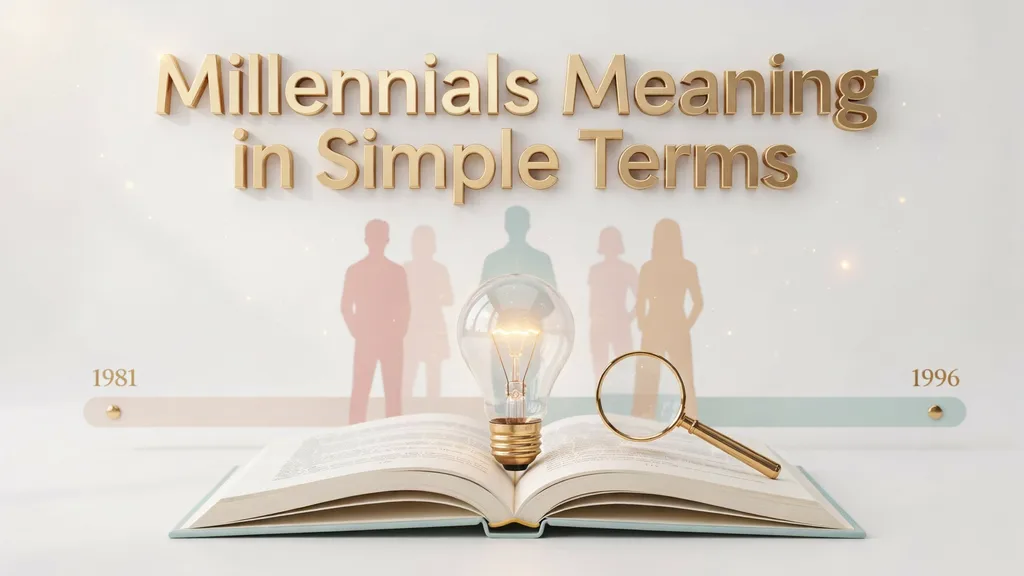
Millennials Meaning in Simple Terms
The word millennials is the plural form of millennial.
A millennial is generally a person born during the period commonly associated with the Millennial generation. One of the most widely used ranges is 1981 through 1996, although different researchers and organizations may use slightly different dates.
For example:
- Someone born in 1985 is generally considered a millennial.
- Someone born in 1990 is generally considered a millennial.
- Someone born in 1995 is generally considered a millennial.
- Someone born in 1975 is generally considered Generation X.
- Someone born in 2002 is generally considered Generation Z.
The exact boundaries are not official laws. Generational labels are social categories used to describe groups of people who grew up during similar periods.
That distinction matters.
Being a millennial does not mean that every person in the generation has the same personality, lifestyle, political views, financial situation, or interests. Two people born in the same year can have completely different experiences.
In everyday language, however, the label is useful because it gives people a quick way to talk about a broad age group and the culture associated with it.
What Does “Millennial” Mean?
Millennial can be used as a noun or an adjective.
As a noun, it refers to a person belonging to the Millennial generation.
For example:
“My sister is a millennial.”
As an adjective, it describes something associated with millennials.
For example:
“That is a very millennial fashion trend.”
The plural form is millennials.
For example:
“Many millennials grew up using early versions of the internet.”
The word comes from millennium, referring to a period of one thousand years. The name became popular because this generation was reaching adulthood around the turn of the millennium.
That is why the term can seem confusing at first. It does not mean that someone was born exactly in the year 2000.
In fact, most definitions place millennials largely in the generation born before 2000.
What Years Are Millennials Born?
There is no single universally agreed definition of the Millennial generation.
However, 1981–1996 is one of the most commonly cited ranges.
This means that, in 2026, millennials are roughly in their late 20s to mid-40s.
Someone born in 1981 would be around 45 in 2026, while someone born in 1996 would be around 30.
You may also see other ranges online, such as 1980–1995 or 1981–1995. These differences happen because generational boundaries are not scientifically fixed in the same way that, for example, a calendar year is fixed.
It is better to think of the dates as a useful guideline rather than a strict rule.
A person’s experiences can also matter more than their exact birth year.
Someone born in 1981 and someone born in 1996 grew up in noticeably different technological environments. The older person may remember life before home internet became common, while the younger person may have spent their teenage years using instant messaging, early social networks, and mobile phones.
Both can still be described as millennials.
Why Are They Called Millennials?
The name Millennials became popular because this generation came of age around the beginning of the new millennium.
The generation is also sometimes called Generation Y, or Gen Y.
The “Y” label followed Generation X. The “millennial” name eventually became much more widely recognized.
The term is especially interesting because millennials experienced a major technological transition during their childhood and teenage years.
Many remember a time when:
- Phones were mostly used for calls and text messages.
- People watched scheduled television programs.
- Music was purchased on CDs.
- Photos were taken with film or basic digital cameras.
- Homework often required visiting a library.
- The internet was accessed through desktop computers.
- Social networking was still relatively new.
- Video games were played on consoles rather than primarily through smartphones.
At the same time, many millennials also adapted to smartphones, streaming services, social media, apps, cloud technology, and other digital tools as adults.
That combination is one reason the generation is frequently discussed online.
Millennials vs. Gen Z
One of the most common questions surrounding this topic is the difference between millennials and Generation Z.
The simplest distinction is age.
Millennials generally came before Gen Z.
Using the commonly cited 1981–1996 range for millennials, Gen Z generally starts around 1997 and continues into the early 2010s, although the exact boundaries vary by source.
The difference is not simply about age, though. The two generations grew up with different relationships to technology.
Many millennials remember the internet becoming part of everyday life.
Gen Z, on the other hand, generally grew up when the internet, smartphones, social platforms, and digital video were already normal parts of childhood.
For example, a millennial might remember:
“I used to wait for the computer to connect to the internet.”
A younger Gen Z person may find that idea almost impossible to relate to because fast internet was already normal when they were growing up.
Of course, these are broad cultural observations, not rules that apply to every individual.
What Does “Millennials” Mean in Text Messages?
When someone uses “millennials” in a text message, the meaning usually does not change.
It still refers to members of the Millennial generation.
However, the context can tell you what the person is really trying to say.
Consider this message:
“Millennials are obsessed with coffee.”
The person is making a general statement about a perceived trend among that generation.
Now consider:
“Only millennials will remember this.”
Here, the word is being used as a reference to shared nostalgia.
The person may be talking about an old television show, toy, website, game, song, fashion trend, or piece of technology that was popular when millennials were young.
Another example:
“My coworkers are mostly millennials.”
In this case, the word is simply being used to describe an age group.
So, “millennials” is not normally internet slang with a secret meaning. It is an ordinary generational label that has become especially common in online conversations.
Is “Millennial” an Insult?
Not necessarily.
The word itself is not an insult.
However, the way someone uses it can be positive, neutral, humorous, or insulting.
For example:
“Millennials grew up with some great music.”
That is a neutral or positive statement.
But someone might write:
“Typical millennial complaining about everything.”
That use is negative and stereotypical.
Social media has made generational jokes extremely common. People sometimes use “millennial,” “Gen Z,” “boomer,” and similar labels as shorthand for stereotypes.
These jokes can be harmless when everyone understands that they are exaggerated.
The problem comes when a stereotype is treated as a fact about every person in a generation.
Not every millennial is financially struggling. Not every millennial loves avocado toast. Not every millennial hates traditional workplaces. Not every millennial is obsessed with social media.
Generational labels describe broad groups, not individual personalities.
Common Millennial Stereotypes Online
If you spend time on social media, you will probably see certain ideas associated with millennials.
Some common examples include:
- Being nostalgic for the 1990s and early 2000s
- Using Facebook more than younger generations
- Remembering dial-up internet
- Having used CDs and DVDs
- Drinking specialty coffee
- Talking about work-life balance
- Being interested in experiences rather than traditional status symbols
- Remembering early social networking websites
- Having grown up with both analog and digital technology
- Using certain expressions or emojis that younger users consider “old-fashioned”
Some of these observations have a connection to real cultural trends. Others are simply jokes.
A meme saying, “You know you’re a millennial when…” is usually not making a serious academic claim. It is inviting people to laugh about shared memories.
That is an important part of understanding the word in social media.
“Only Millennials Remember This” Meaning
You may frequently encounter the phrase:
“Only millennials remember this.”
This usually means:
“People from the Millennial generation are likely to remember this thing from their childhood or teenage years.”
It is often used with nostalgic content.
For example, a post might show an old computer, a discontinued snack, a television character, a game console, or an early internet website and say:
“Only millennials remember this.”
The statement is usually exaggerated.
People from other generations may remember the same thing too. The point is simply to create a feeling of nostalgia among a particular age group.
This type of content performs well on social media because shared memories can make people feel connected.
Examples of Millennials Used in Text
Here are some realistic examples of how the word might appear in everyday conversation.
Example 1: Talking about age
“My manager is a millennial.”
Meaning: The speaker’s manager belongs to the Millennial generation.
Example 2: Talking about technology
“Millennials were the first generation to grow up alongside the internet.”
Meaning: The speaker is discussing the generation’s experience with technological change.
Example 3: Social media humor
“Millennials still use Facebook 😂”
Meaning: The speaker is joking about perceived differences in social media habits.
Example 4: Nostalgia
“This song takes me straight back to my millennial childhood.”
Meaning: The speaker associates the song with memories from growing up.
Example 5: Workplace discussion
“The company is trying to attract more millennials.”
Meaning: The company wants to appeal to people from that generation, perhaps as employees or customers.
Example 6: Generational comparison
“Millennials and Gen Z have very different experiences with technology.”
Meaning: The speaker is comparing two generations.
In each example, the surrounding sentence tells you whether the term is being used seriously, casually, or humorously.
Millennials on Social Media
Social media has played a major role in how the Millennial generation is discussed.
Many millennials were old enough to remember the early stages of online social networking. They experienced platforms and online communities developing from relatively simple websites into major parts of everyday communication.
This makes millennials something of a bridge generation.
They remember a childhood that was not completely digital, but they also became adults during the rapid expansion of the internet.
That is why you may see millennials described as the generation that remembers both “before the internet” and “after the internet.”
Again, this is a simplification.
A millennial born in the mid-1990s had a very different childhood from someone born in the early 1980s. Internet access also varied significantly by country, household income, location, and family circumstances.
Still, the transition itself is an important part of the generation’s cultural identity.
Are All Millennials the Same?
Definitely not.
This is one of the most important things to understand when using generational labels.
A generation can contain millions of people from different countries, cultures, religions, economic backgrounds, professions, and family situations.
Even people born in the same year can have completely different childhoods.
For example, a person growing up in a large city with early internet access may have had a very different experience from someone growing up in a rural community where internet access arrived much later.
Economic conditions also matter.
So when you see a sentence like “Millennials do this,” it is worth asking whether the person is talking about a genuine demographic trend or simply repeating an internet stereotype.
Good discussions about generations use these labels as broad descriptions rather than absolute rules.
Why Do People Talk About Millennials So Much?
There are several reasons.
First, millennials make up a large and influential portion of the adult population in many countries.
Second, they experienced major changes in technology during their formative years.
Third, their transition into adulthood overlapped with significant economic and social changes.
Millennials are also now at very different life stages than they were when the label first became popular.
The oldest millennials are middle-aged adults. Many have careers, children, homes, businesses, or leadership positions.
This means the way people talk about the generation has changed over time.
A decade ago, an article might have discussed millennials as young adults entering the workforce.
Today, many millennials are experienced professionals and established adults.
That is another reason it is important not to rely too heavily on old stereotypes.
Millennial Meaning in Workplace Conversations
You may also see the word in discussions about employment.
For example:
“Millennials want flexible working arrangements.”
This kind of statement is usually referring to research or perceived trends involving workers from that generation.
Topics often include:
- Remote work
- Flexible schedules
- Career development
- Workplace culture
- Salary
- Benefits
- Work-life balance
- Management styles
- Job satisfaction
However, workplace preferences are influenced by many factors besides generation.
Age, industry, career stage, income, family responsibilities, location, and personality can all affect what someone wants from a job.
Therefore, it is more accurate to say that some workplace trends may be more common among certain age groups than to assume that every millennial wants the same thing.
Millennials and Popular Culture
Popular culture is another area where the label appears frequently.
A movie, television show, song, fashion style, or video game might be described as “millennial.”
Usually, this means it became popular during the generation’s childhood, adolescence, or early adulthood.
For example, someone might call a particular early-2000s song “millennial nostalgia.”
They are not necessarily saying every millennial likes it.
They are saying that the cultural object is strongly associated with the generation.
This distinction makes the term easier to understand.
Millennial vs. Boomer: Why the Terms Appear Together
You may also see “millennial” used alongside boomer.
A baby boomer generally refers to someone from the post-World War II Baby Boom generation, while a millennial belongs to a much younger generation.
Online, however, “boomer” can sometimes be used more loosely.
For example, someone might call another person a “boomer” because they seem unfamiliar with modern technology, even if that person is not actually a member of the Baby Boomer generation.
This is an example of how generational terms can become internet slang.
The literal meaning and the online meaning are not always identical.
The same thing can happen with “millennial.”
Someone might describe a person as “so millennial” because of their taste in music, clothing, technology, or humor rather than because they have confirmed the person’s birth year.
Millennial vs. Gen X vs. Gen Z
It can help to see the commonly used generational sequence:
Baby Boomers → Generation X → Millennials → Generation Z → Generation Alpha
The boundaries vary depending on the source, but the general order remains the same.
Millennials are therefore positioned between Generation X and Gen Z.
One useful way to think about the groups is through technology:
Generation X: Many grew up before personal digital technology became widespread.
Millennials: Many experienced the transition from an offline childhood to an increasingly connected adulthood.
Generation Z: Many grew up with smartphones, social media, and constant internet access as normal parts of life.
These descriptions are broad, but they help explain why generational labels are so common in conversations about technology and culture.
Does “Millennials” Have a Special Slang Meaning?
Usually, no.
If someone simply writes:
“Millennials”
they are normally referring to the generation.
But social media has given the term additional cultural meanings.
Depending on context, it can suggest:
- Nostalgia
- A certain style of humor
- A shared childhood experience
- A perceived attitude toward work
- A particular relationship with technology
- A generational stereotype
- A joke about age
The surrounding words matter.
If someone says, “Millennials remember this,” they are probably talking about nostalgia.
If someone says, “Millennials killed the housing market,” they are making a claim about economic behavior or circumstances.
If someone says, “That emoji is so millennial,” they are probably joking about communication styles.
The word itself has not changed meaning. Its context and tone have.
How to Respond When Someone Calls You a Millennial
If someone calls you a millennial, there is usually no need to treat it as an insult.
You can simply respond normally.
If they are making a joke, you could joke back.
For example:
“Guilty. I still remember burning CDs.”
Or:
“Yep, and I still miss my old MP3 player.”
If the person is using the label negatively, you can challenge the stereotype if you want.
For example:
“Being a millennial doesn’t mean everyone has the same lifestyle.”
The best response depends entirely on the conversation.
Common Questions About Millennials
What is the simple meaning of millennials?
Millennials are members of a generation generally born from the early 1980s to the mid-1990s. A commonly used definition places them between 1981 and 1996.
Are millennials Gen Y?
Yes. Millennials and Generation Y generally refer to the same generation.
“Millennial” became the more widely used name.
Are people born in 2000 millennials?
Generally, no. People born in 2000 are usually classified as Generation Z under commonly used generational definitions.
What age are millennials in 2026?
If you use the commonly cited 1981–1996 range, millennials are approximately 30 to 45 years old in 2026, depending on their birthday.
Why are millennials called millennials?
They are called millennials because the generation came of age around the beginning of the new millennium.
Is millennial a bad word?
No. The word itself is neutral. It can be used positively, negatively, or humorously depending on context.
What does “millennial” mean on TikTok?
On TikTok and other social platforms, it can simply refer to a member of the Millennial generation. It is also frequently used in jokes about nostalgia, technology, language, fashion, and perceived generational habits.
What does “only millennials remember” mean?
It is usually a nostalgic phrase suggesting that something was popular during the childhood or teenage years of millennials. It is often an exaggeration rather than a literal claim.
The Bottom Line
So, what does millennials mean? In its basic sense, millennials are people belonging to the Millennial generation, commonly defined as those born from 1981 through 1996. In text messages and social media, the word usually has the same basic meaning. However, the tone can change depending on context.
Someone may use “millennials” to talk about age, technology, workplace trends, popular culture, or shared memories. Online, the term is also frequently used for jokes and stereotypes, particularly around nostalgia for the 1990s and 2000s.
The most important thing to remember is that a generation is a broad category, not a personality type. Not every millennial acts the same way, likes the same things, or has the same life experiences.
If you see the word in a text, simply look at the sentence around it. If the conversation mentions childhood memories, old technology, or nostalgia, it is probably being used in a cultural or humorous way. If the conversation is about age, employment, demographics, or society, it is probably being used more literally.
In short, “millennials” means members of the Millennial generation, but on social media the word can also carry a sense of shared nostalgia, humor, and cultural identity.
Discover more post
What Does lion tattoo meaning Mean in Text? 2026
What Does well said meaning Mean in Text? 2026
What Does duality meaning Mean in Text? 2026

Ruby Maea is an experienced content writer & humor expert based in the United States, known for creating clean, clever, and viral content that resonates with global audiences. With a passion for wordplay, puns, and shareable humor, Ruby helps readers laugh, connect, and spread positivity online.